
Why Does My Bra Band Ride Up My Back? Causes & Corrective Action
If the back of your bra band arches upward toward your shoulder blades throughout the day instead of sitting in a crisp horizontal line across your ribcage, your bra is failing to provide baseline structural support. Here is exactly why this happens, the biomechanics involved, and how to definitively fix it.
The Biomechanical Failure of a Creeping Bra Band
There is nothing more exhausting than constantly reaching behind your back in public to yank down a band that refuses to stay anchored. You adjust your straps, pull the back down, and within twenty minutes of walking or sitting, the back wing has crept right back up between your shoulder blades into a steep 'U' shape.
This upward creeping is not your fault—it is pure physics. When an underbust band is too large for your ribcage circumference, it lacks the frictional tension required to counteract the downward cantilever of your breasts. The heavier front pulls down, and like a playground seesaw, the loose back shoots upward. The moment this happens, your shoulder straps become load-bearing ropes, digging deep painful grooves into your trapezius muscles and triggering chronic tension headaches.
Furthermore, the psychological toll is immense. Countless individuals step into fitting rooms only to be told they are a size that feels completely wrong, or worse, that their true size simply "doesn't exist." This gaslighting by the retail industry forces millions to wear the wrong size, leading to body dysmorphia and a feeling that their body is somehow "wrong." Your body is not wrong. The math used by modern fast-fashion brands is wrong. You deserve better, and the solution starts with understanding the physics of proper support.
1. The Mechanical Physics of a Sliding Band
In a properly engineered bra, 80% of total bust support is generated by the underbust band through friction and tension against your ribcage wall. When a band is too large (e.g. wearing a 36 band on a 31 underbust), the band lacks sufficient friction to anchor in place. It essentially floats around your torso.
Think of the mechanics like a suspension bridge. The main cables (the band) must be perfectly tensioned to carry the load. If those anchors are loose, the entire structure fails. Your shoulder straps are only meant to provide the remaining 20% of support—primarily keeping the cups flush against your chest, not lifting the actual weight of breast tissue.
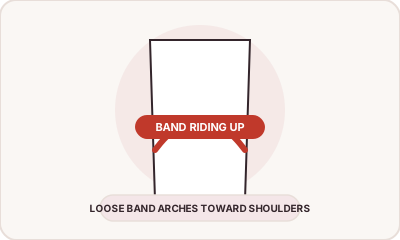 Figure 1: Vector tension pulling loose back band upward toward neck
As gravity pulls breast tissue downward in the front, the shoulder straps act as a leverage pulley over your shoulders, yanking the loose back band upward toward your shoulder blades. What do most people do when they feel this lack of support? They tighten the shoulder straps. Tightening the shoulder straps further only worsens the upward tilt, digging painful red grooves into your shoulders while entirely failing to lift your bust. It is a vicious cycle that can only be broken by downsizing the band.
2. The Three Primary Root Causes of Band Upward Displacement
A riding-up band does not happen by accident. It is almost always the result of one of three specific sizing or wear-and-tear failures. Understanding these root causes empowers you to avoid them in the future.
Root Cause A: Outdated "+4" Sizing Formulas
Historically, before the invention of modern stretch fabrics like elastane and spandex, garments were made of rigid cotton. To allow individuals to breathe, tailors instructed them to add 4 or 5 inches to their actual underbust measurement.
Today, fabrics stretch dynamically. Yet, many old retail sizing charts still instruct shoppers to add 4 inches to their underbust measurement (e.g., if you measure 30 inches, they tell you to wear a 34 band). Why? Because by adding 4 inches to your band size and shrinking your cup size, brands can force a massive variety of body types into a highly restricted, cheap-to-manufacture matrix of 32A to 38DD. It is a financial decision, not an ergonomic one. This yields a band that is 4 inches too wide to hold tension against modern elastane fabrics, guaranteeing band movement and chronic riding up.
Root Cause B: Elastic Fiber Degradation
Even if you buy the perfect size, it will not last forever. Over 6 to 9 months of regular wear, body heat, and washing, the internal elastane threads lose their elasticity. They begin to permanently stretch out, expanding up to 2 full inches beyond their original unstretched length. When a 34 band stretches out to behave like a 36 band, it loses its anchoring grip. If your bra used to fit perfectly but now rides up constantly, the garment has simply reached the end of its structural lifespan.
Root Cause C: Fastening on Inner Hooks when New
A brand-new bra should always fit snugly on the OUTSIDE (loosest) set of hooks. The inner hooks are designed exclusively for future use. As the elastic degrades and stretches out over those 6 to 9 months (as described in Root Cause B), you move inward to the second hooks, and eventually the tightest hooks, to maintain the same level of friction. If you start on the tightest hooks when buying a brand-new bra, you have zero room to tighten the garment as it naturally relaxes over time. The moment it stretches, it will begin riding up your back.
3. Recommended Sister Size Adjustments
To fix a riding-up band, you must step down to a smaller band size to regain the necessary friction against your ribcage. However, cup sizes are not static; they are proportional to the band size. The cup on a 36C is much larger in volume than the cup on a 32C.
Therefore, to preserve the exact same cup volume capacity while tightening the band, you must simultaneously step up by one cup letter. This is known as Sister Sizing.
| Current Riding-Up Size | Corrective Sister Size | Volume Preservation Result |
|---|---|---|
| 36C (Band rides up) | Try 34D | Same ~590 cc cup volume; 2 inches tighter band anchor. |
| 34D (Band rides up) | Try 32DD (or 32E UK) | Same ~590 cc cup volume; 2 inches tighter band anchor. |
| 38B (Band rides up) | Try 36C | Same ~590 cc cup volume; 2 inches tighter band anchor. |
| 32C (Band rides up) | Try 30D | Same ~390 cc cup volume; 2 inches tighter band anchor. |
| 40DD (Band rides up) | Try 38E (or 38DDD US) | Same ~1000 cc cup volume; 2 inches tighter band anchor. |
If your band is severely loose—meaning it rides up more than 3 or 4 inches—you may need to go down two band sizes. In that case, you must go up two cup letters. For example, moving from a very loose 36C directly to a 32DD.
Calculate your exact smaller-band sister size safely and accurately using our Sister Size Calculator.
4. Step-by-Step Diagnostic Fit Audit
You don't need to guess if your band is too loose. You can definitively test it right now. Put on your current bra, fasten it on the loosest hooks, swoop and scoop your breast tissue into the cups, and perform these three simple physical tests in front of a mirror:
- The Horizontal Line Test:Stand sideways in front of your mirror. Trace the bottom edge of the band from the front to the back. The back of the band should sit at the exact same height as the front underwires, parallel to the floor. If the back sits higher than the front, the band is too large.
- The Two-Finger Lift Test:Reach behind your back and insert exactly two fingers flat against your spine, directly beneath the bra band. You should feel firm, secure resistance. Now, pull outward away from your body. If you can easily pull the band more than 2 inches away from your spine, the band lacks the tension required to support your bust. It is too large.
- The Arm Extension Test:Stand straight and rapidly reach both arms high over your head, as if reaching for a top shelf. Watch the underwires in the front. If the band slides upward over your breast tissue (creating "underboob"), the band is too loose. A properly fitted band will stay locked against your ribcage wall regardless of arm movement. If you fail this test, immediately downsize your band.
The Long-Term Impact of Ignoring Fit Issues
In addition to the immediate physical pain of straps falling down or underwires digging into sensitive breast tissue, the long-term musculoskeletal impact is undeniable. When you settle for the restrictive 'standard sizing matrix' sold in massive retail chains (often artificially capped at a DDD cup), you force your body into a mold it was never meant to fit.
This constant compression alters how you breathe, limits your chest expansion during aerobic activities, and even changes the way your clothes drape over your silhouette. A band that shifts around causes constant friction, leading to skin chafing, hyperpigmentation, and painful abrasions over time. Furthermore, without the band doing the heavy lifting, your delicate breast tissue is subjected to increased gravitational stress, which can accelerate the stretching of the Cooper's ligaments (the structural tissue within the breast).
When you finally discover your mathematically correct size—anchoring the band firmly against the ribcage wall to bear 80% of the load—the physical relief is instantaneous. The shoulder straps no longer dig deep trenches into your skin. The underwires no longer sit on sensitive breast tissue. The center gore tacks perfectly flat against the sternum. Your silhouette is lifted, your posture improves, and you can finally breathe deeply without restriction.
We strongly encourage you to trust the math, measure accurately, and demand garments that respect the actual physics of your body. Your body deserves the mathematical accuracy of a custom fit, not a generic retail approximation. It is an investment in your daily comfort, your long-term posture, and your overall confidence.
5. Re-Calculate Your Baseline Size Today
Stop suffering through the pain of a riding-up band. Use our precise measurement tools below to find your true structural band size, verify sister sizing transitions, and finally secure the correct level of support.
Frequently Asked Questions
Why does my bra band ride up my back?↓
A bra band rides up because the band size is too large or the elastic has stretched out over time. When the band lacks snug friction against your ribcage, the weight of your bust pulls the shoulder straps down in front, causing the back of the band to arch upward toward your shoulder blades.
How do I fix a bra band that slides up without shrinking the cup size?↓
To fix a riding-up band while preserving cup volume, apply sister sizing: reduce your band size by one even number and increase your cup letter by one step (e.g. move from a loose 36C to a supportive 34D).
How tight should a bra band feel around my ribcage?↓
A properly fitting bra band should feel firmly snug against your ribcage wall on the outermost set of hooks. You should be able to slide no more than two fingers beneath the band at your spine. The band must stay completely horizontal all day without shifting when you raise your arms.