
Visual Bra Size Chart with Pictures: Master International Matrix
Let's be incredibly honest for a moment: navigating the tangled web of international bra sizes is utterly exhausting. You finally find a bra that makes you feel supported, confident, and comfortable, only to realize it's from a UK brand while you live in the US, or it's a European label that uses a completely different numbering system. Suddenly, the size that fits you perfectly in one store is entirely wrong in another. It’s enough to make anyone want to give up and live in sports bras forever.
If you’ve ever felt like you need a mathematics degree just to decode a bra tag, you are not alone. Millions of women and bra-wearers experience this exact same frustration every single day. The sizing systems across the world evolved independently, leading to a chaotic overlap of inches, centimeters, and mismatched cup letters. It's not your body that is the problem—it is a deeply flawed, historically disjointed apparel industry. But we believe that finding a bra that fits your unique body shouldn't feel like a punishment.
Every bra size consists of two crucial elements: a band number (representing the circumference of your ribcage, the true foundation of support) and a cup letter (representing the volume displacement of your breast tissue). To take the guesswork out of your shopping experience, we’ve developed the ultimate Master Bra Size Chart below. You can seamlessly cross-reference sizes across 10 major global regions, ensuring you find your perfect fit no matter where your favorite lingerie originates.
International Size Conversion Matrices
Search or filter below to highlight equivalent band and cup sizes across regions.
Band Size Conversion MatrixUS / UK / EU / FR / AU / JP / IN / HK / KR / SG
| US / CA | UK | EU | FR / BE / ES | AU / NZ | JP | India (IN) | Hong Kong (HK) | South Korea (KR) | Singapore (SG) |
|---|---|---|---|---|---|---|---|---|---|
| 30 | 30 | 65 | 80 | 8 | 65 | 30 | 65 | 65 | 65 |
| 32 | 32 | 70 | 85 | 10 | 70 | 32 | 70 | 70 | 70 |
| 34 | 34 | 75 | 90 | 12 | 75 | 34 | 75 | 75 | 75 |
| 36 | 36 | 80 | 95 | 14 | 80 | 36 | 80 | 80 | 80 |
| 38 | 38 | 85 | 100 | 16 | 85 | 38 | 85 | 85 | 85 |
| 40 | 40 | 90 | 105 | 18 | 90 | 40 | 90 | 90 | 90 |
Cup Size Conversion MatrixUS / UK / EU / AU / JP / IN / HK / KR / SG
| US / CA | UK | EU | AU / NZ | JP | India (IN) | Hong Kong (HK) | South Korea (KR) | Singapore (SG) |
|---|---|---|---|---|---|---|---|---|
| A | A | A | A | A | A | A | A | A |
| B | B | B | B | B | B | B | B | B |
| C | C | C | C | C | C | C | C | C |
| D | D | D | D | D | D | D | D | D |
| DD / E | DD | E | DD | E | DD / E | E | E | E |
| DDD / F | E | F | E | F | E / F | F | F | F |
| G | F | G | F | G | F / G | G | G | G |
| H | FF | H | FF | H | G / H | H | H | H |
| I | G | I | G | I | H | I | I | I |
| J | GG | J | GG | J | I | J | J | J |
1. How to Read & Use This Master Chart
Looking at a grid full of numbers and letters can feel overwhelming. Take a deep breath. You are completely capable of figuring this out, and we are here to hold your hand through the process. The chart above acts as a decoder ring for the entire bra industry. Once you have your baseline measurements, using this matrix becomes second nature. Follow these simple steps to confidently locate your size:
- Find Your Band Row: Think of the band as the foundation of a house; if it's unstable, nothing else will work correctly. Up to 80% of your bra's support should come from the band around your ribcage, not the shoulder straps. Locate your snug underbust measurement in either inches or centimeters on the Band Size Conversion Matrix above. For instance, if you measure 34 inches, you would look across that row to see that your European size is 75, your French size is 90, and your Australian size is 12.
- Find Your Cup Column: Your cup size isn't a static bowl; it's a dynamic ratio. It represents the difference between your full bust measurement and your underbust measurement. Locate your calculated bust-to-band delta in the Cup Size Conversion Matrix to identify your regional letter. This is where sizes often diverge wildly—a DD in the US is very different from an E in Europe.
- Cross-Reference Your Destination Region: Now that you have both your converted band and cup, simply combine them. Read horizontally across the row to find your target country's equivalent size tag. So, a US 34DD might become a UK 34DD, but in France, it would be labeled a 90E.
A quick pro-tip: When in doubt, always look at the brand's country of origin. A bra designed by a British brand will be manufactured using UK sizing standards, even if you are buying it in a boutique in New York, Tokyo, or Sydney.
The Truth About Bra Sizing Variations
It is completely normal to feel frustrated when a 36D fits perfectly in one brand, but you can barely hook a 36D in another. We want to validate that experience: you aren't doing anything wrong, and your body isn't "weird." The lingerie industry is notoriously inconsistent. Brands use entirely different fit models to create their base patterns (known in the industry as blocks). If a brand's fit model has wider-set breasts or a broader ribcage, their cups will be constructed differently than a brand using a model with close-set, high-profile breasts.
Additionally, fabrics play a massive role in how a garment performs on your body. A stretchy lace band will feel entirely different from a rigid satin or strong powermesh one, even if they are cut to the exact same measurements. Did you know that darker dyes (like black, navy, or deep reds) can sometimes shrink fabrics slightly during the manufacturing process? This is a little-known secret that explains why a black bra often feels tighter than the exact same bra in a beige or pastel color.
Always remember that the size on the tag is merely a starting point—a helpful suggestion from the manufacturer. Your ultimate goal is comfort, support, and feeling great in your clothes. If you need to size up or down to achieve that feeling, do it without a second thought. The tag doesn't define your body; your comfort dictates the fit.
Troubleshooting Common Fit Issues
Finding your size on a chart is just the beginning of the journey. Once you actually put the bra on, your body will tell you the real story. Let's talk about some of the most common fit issues and how you can troubleshoot them effectively. Remember, it is the garment's job to fit you, not your job to squeeze into the garment.
The Band Rides Up Your Back
If the back band of your bra is forming an inverted "U" shape and riding up toward your shoulder blades, the band is too loose. A loose band forces the shoulder straps to carry the heavy weight of your breasts, which leads to painful shoulder indentations, tension headaches, and neck strain. Try going down one band size. Because you are decreasing the band size, remember to use the Sister Size principle and go up one cup size to maintain the same breast volume (e.g., switch from a 36C to a 34D).
The Center Gore Doesn't Sit Flat
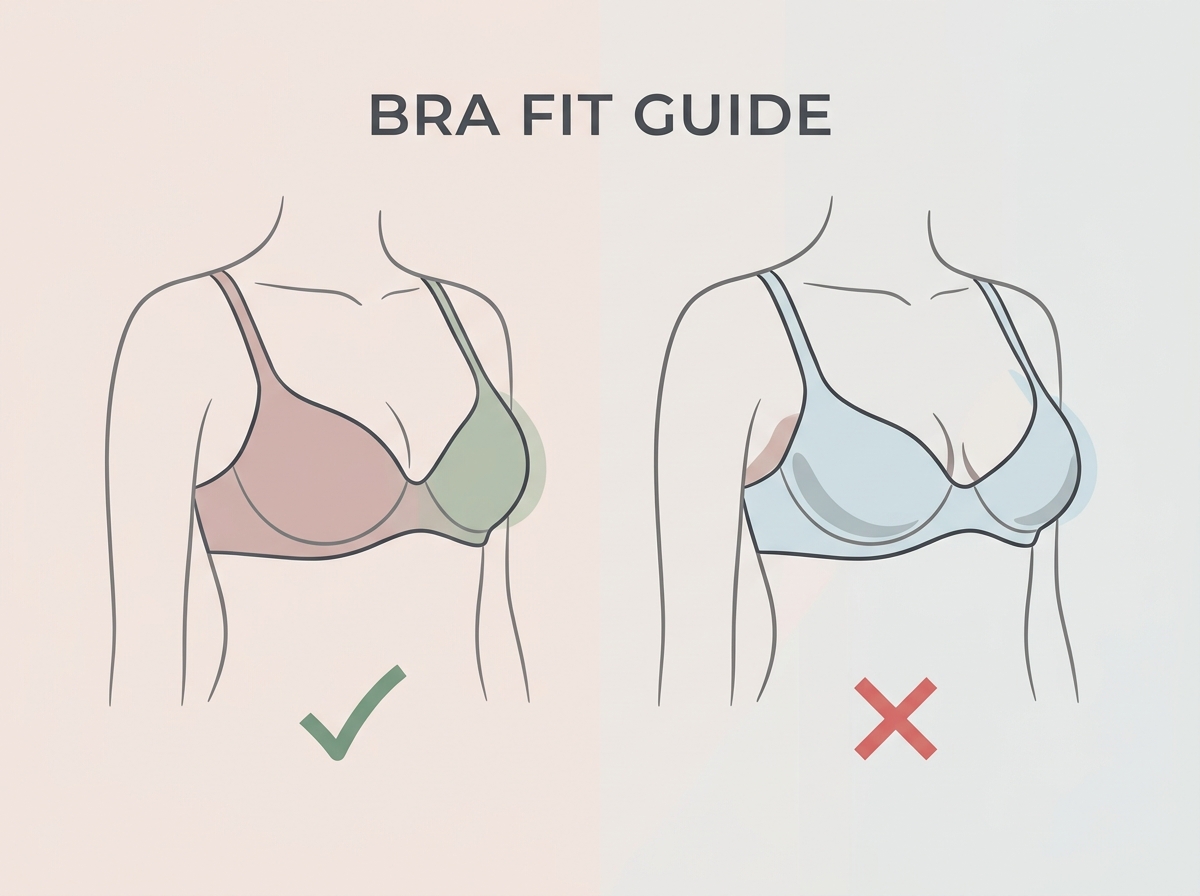
The center gore is the small piece of fabric and underwire that sits right between your breasts. In a well-fitting underwired bra, this gore should tack completely flat against your sternum. If it is floating away from your chest, or sitting on top of your breast tissue, it is a glaring indicator that the cups are too small. Your breasts are actively pushing the cups outward, pulling the gore away from your body. You will likely need to go up at least one cup size, and sometimes two, to give your tissue enough room to settle.
Straps Are Constantly Slipping
Slipping straps can be absolutely infuriating, especially if you have narrow or sloping shoulders. However, they are also a key sign of a band that is too large. When the band is too loose, the straps are positioned wider apart on your back, making them far more likely to slide off. Sizing down in the band often brings the straps closer together. If you've corrected your band size and still experience slipping, look for "racerback" styles, or bras with fully adjustable straps, as well as styles designed with "leotard" (U-shaped) backs.
The Cups Are Wrinkling or Gaping
When you notice empty space, wrinkling, or gaping at the top or sides of your cups, the instinct is usually to assume the cup is too large. Often, this is correct—you simply need to drop down a cup volume. But occasionally, gaping happens when the cup is actually too small or the wrong shape! If a cup is too shallow for your breast shape (often the case with molded seamless "T-shirt" bras), your breast will push the bra away from your chest, creating a gap at the top. If sizing down doesn't fix the issue, you may need to try a seamed, unlined bra that accommodates more natural projection.
Interactive Tools & Calculators
Still feeling unsure? You don't have to do the complex math in your head. We've built an entire suite of intuitive tools designed to take the mental load off your shoulders. Whether you need to calculate your size from scratch or figure out your sister sizes for a tricky brand, our main Hub pages have you covered. Use these resources to verify your fit.
Frequently Asked Questions
We hear these questions all the time from people just like you who are trying to make sense of the chaos. Here are our most honest, straightforward answers to help you navigate the complexities of bra fitting.
How do I read an international bra size chart?↓
Locate your snug underbust measurement in either inches or centimeters on the band matrix row. This reveals your equivalent band size across regions (e.g. 34 in US/UK = 75 in EU = 90 in FR = 12 in AU). Next, locate your bust-to-band delta in the cup matrix to find your regional cup letter. Combine the two for your final converted size.
Why do Asian bra sizes (Japan, Hong Kong, Korea, Singapore) use metric band numbers?↓
Asian bra sizing systems (such as Japan JIS L 4006 and South Korea KS K 9404) follow metric EN 13402 specifications. They use your literal underbust measurement in centimeters for band numbers (such as 65, 70, 75, 80) and calculate cups using 2.5 cm delta increments, making it one of the most logically consistent systems.
Are UK and US bra sizes the same?↓
Up to a DD cup, UK and US bra sizes are identical. However, after a DD cup, the sizing systems diverge significantly and cause a lot of confusion. The UK system uses double letters consistently (DD, E, F, FF, G, GG), while the US system often uses multiple Ds (DDD) and skips double letters (G, H, I). Always check the brand's country of origin.
Why does the same size fit differently depending on the brand?↓
Beyond regional sizing differences, brands use unique design blocks, specific fit models, and varying fabric stretch levels. A stretchy lace band feels different from a rigid mesh one, even if cut exactly the same. Manufacturing tolerances and dye shrinkage (like with black dyes) also cause variations. Your size is a starting point, not a guarantee.
How can I tell if my bra cup is too small?↓
Signs of a too-small cup include breast tissue spilling over the top edge (causing a "quad-boob" effect), tissue escaping at the underarms, or the underwire resting on breast tissue instead of sitting flat against your ribcage. If you experience these, try going up one or two cup volumes.
What exactly is sister sizing?↓
Sister sizes hold the exact same cup volume, but are attached to different band sizes. For example, the cup of a 34C holds the same volume as a 36B or a 32D. If a band is too tight but the cup volume fits perfectly, you go up a band size and down a cup size (e.g., 34C to 36B) to maintain the exact same volume.
Is a D cup the same size on every band?↓
Absolutely not. Cup sizes are not static volumes; they represent a ratio or difference between your bust and underbust measurements. A 32D is significantly smaller in overall volume than a 40D. The letter only tells you the relative proportion to the band, not the absolute size of the cup.
How often should I measure my bra size?↓
We recommend checking your measurements every six months, or whenever you experience significant life changes. Weight fluctuations, pregnancy, nursing, hormonal shifts, and starting new fitness routines can all alter your breast shape and ribcage size. Your body naturally evolves over time, and your bras should keep up.