
International Bra Size Converter
Select your known bra size and country standard below to convert your equivalent band and cup sizes across US/CA, UK, EU, FR, AU/NZ, JP, IN, HK, KR, and SG sizing conventions instantly.
Bra Size Converter Tool
Entered Size: 34C (US/CA)
Navigating the Exhausting Maze of International Bra Sizing
Let's be incredibly honest for a moment: buying a bra shouldn't require an advanced degree in mathematics. Yet, standing in a fitting room—or staring at a checkout screen on a gorgeous European boutique's website—trying to decode exactly what a US 34DD translates to in French or European sizing can feel completely, utterly overwhelming. It is frustrating, it is confusing, and quite frankly, it can make you want to give up on finding a bra that actually fits you well.
We've all been there. You finally find the perfect bra online. The fabric looks absolutely divine, the cut is exactly the silhouette you've been searching for, and you're ready to hit 'add to cart'. But then you look at the sizing dropdown and see numbers and letters that look like a completely foreign language—or worse, numbers you recognize but paired with letters that make zero sense for your body. You are not alone in this struggle. The unfortunate reality of the global lingerie market is that there is absolutely no universal standard. Different regions and countries have evolved their own unique sizing systems based on completely different historical measurement conventions, manufacturing practices, and cultural norms.
This is not just about aesthetics or vanity; it's deeply tied to your comfort, your support, and your day-to-day physical well-being. A bra that doesn't fit properly—whether the band is mercilessly digging into your ribcage and restricting your breathing, or the cups are gaping and failing to provide the support you need—can ruin your posture, cause chronic back and shoulder pain, and completely destroy your confidence. When your foundational garment isn't right, your entire day feels off. But don't worry. You don't have to navigate this intricate maze blindly.
We've built this interactive converter to be your trusted, foolproof guide, cutting straight through the confusion and giving you the precise, mathematical answers you need instantly. Whether you're shopping from an exquisite French boutique, trying out a highly-rated British brand renowned for their incredible large-cup support, or just trying to decipher the complex, multi-national tags on the bras you already own in your drawer, mastering international conversion is the master key to unlocking a world of better-fitting, more supportive, and more comfortable lingerie. If you're completely unsure of where to even begin and don't know your starting size, you might want to visit our main Bra Size Hub to ensure you have a highly accurate starting point before attempting to convert your size across borders. Getting your initial measurement right is the single most important step before engaging with any conversions.
1. Master the Complex Global Conversion Rules
Understanding international sizing conversion requires you to evaluate two entirely separate variables: the underbust band numbers, and the overbust cup letters. It is absolutely crucial to realize that these two components do not always change at the same rate across different countries. Sometimes the band size translates directly, but the cup size shifts completely. Other times, it's the exact opposite. Let's break down the underlying mechanics of these systems so you never feel lost again.
The Global Band Conversion Reference Matrix
Band sizes are the absolute foundation of your bra's support system. In fact, a properly fitted band should be providing approximately 80% of the heavy lifting, taking the strain off your shoulders and straps. In the US, UK, and India, bands are traditionally measured in inches. In most of Continental Europe, Japan, and other Asian markets, they are measured in centimeters. This matrix below provides a clear, reliable translation across the globe.
| US / UK / IN (Inches) | EU / JP / HK / KR (cm) | FR / BE / ES (cm) | AU / NZ Dress Size |
|---|---|---|---|
| 30 inches | 65 cm | 80 cm | Size 8 |
| 32 inches | 70 cm | 85 cm | Size 10 |
| 34 inches | 75 cm | 90 cm | Size 12 |
| 36 inches | 80 cm | 95 cm | Size 14 |
| 38 inches | 85 cm | 100 cm | Size 16 |
| 40 inches | 90 cm | 105 cm | Size 18 |
Pro-Tip for Band Conversions
When converting from inches to centimeters (like moving from US sizing to EU sizing), you might notice that the direct mathematical conversion doesn't perfectly align with the size chart. For example, 34 inches is exactly 86.36 cm, but a US 34 band converts to an EU 75 band. Why? Because the EU sizing system has a built-in 'ease' measurement—they traditionally add roughly 10cm to the actual underbust measurement to determine the final band size on the tag. This is why you must always trust the established conversion charts rather than trying to do raw mathematical conversions in your head. Trying to calculate this yourself will almost always lead to purchasing a band that is entirely too loose for proper support.
2. The Absolute Chaos of Regional Cup Divergence
While band sizes are relatively straightforward to convert once you understand the core rules, cup sizes are where the real chaos begins. Up to a D cup, almost the entire world agrees: an A is an A, a B is a B, a C is a C, and a D is a D. It is delightfully simple. But the very moment you need a cup larger than a D, the global systems fracture entirely. This is universally recognized as the single biggest pain point for bra shoppers globally. Let's demystify these regional quirks so you can shop with confidence, no matter where a brand is based.
🇺🇸 North America (US & CA)
The US system is notoriously inconsistent above a D cup. It is practically the wild west of lingerie sizing. Some major brands use multiple D's (such as DD, DDD, DDDD), while others switch entirely to a single letter progression (DD, F, G, H, I). This means if you are a US size DDD in one brand, you might very well be labeled an F in another US brand, despite them both being domestic companies. It requires incredibly careful attention to the specific brand's sizing chart before purchasing. As a general rule for our converter, we use the standard, most widely accepted US progression: DD, DDD/F, G, H, I, J, K.
🇬🇧 United Kingdom (UK & Commonwealth)
The UK sizing system is widely considered the absolute gold standard for full-bust sizing because it is highly standardized, extremely precise, and logically structured. Instead of just jumping to a new letter, they utilize double letters to thoughtfully denote half-cup steps in volume: D, DD, E, F, FF, G, GG, H, HH, J, JJ. If you are shopping for a cup size larger than a DD, UK brands (like Panache, Freya, Curvy Kate, and Elomi) often provide the most consistent, supportive, and well-engineered fit on the market. Note that a UK 'E' cup is completely different from a US 'E' cup; a UK 'E' is actually equivalent to a US 'DDD'.
🇪🇺 Continental Europe (EU, JP, KR, HK, SG)
European and many Asian systems keep things seemingly straightforward by strictly using single letters, progressing straight through the alphabet: A, B, C, D, E, F, G, H, I, J. They completely reject the concept of double letters (you will virtually never see a DD or FF in true EU sizing). However, this creates a major trap for international shoppers: an EU 'E' cup is significantly smaller than a UK 'E' cup. In fact, a UK 'E' actually translates to an EU 'F'. If you are buying a premium European brand (like PrimaDonna, Chantelle, or Simone Pérèle), you must pay incredibly close attention to this shift, or you will end up with cups that are uncomfortably tight and cause "quad-boob."
A vital piece of insider advice: When buying internationally, you must always check whether the brand uses their native country's sizing system, or the sizing system of the country you are currently shopping in. Many top-tier British brands sold in US department stores will still list their UK size on the tag, causing mass confusion for American buyers who think they are picking up a US 'G' cup when it is actually a much larger UK 'G'. Always check the tag for the regional indicators (UK, US, EU, FR).
3. Troubleshooting: What to Do When the Converted Size Doesn't Feel Right
So, you've used the converter. You've read the charts. You know exactly what your size should be in that beautiful French boutique. You excitedly order the bra, wait for it to arrive, finally slip it on... and your heart sinks. It just doesn't feel right. First, take a deep breath. You didn't do the math wrong, and our converter isn't broken. This is an incredibly common experience, and it comes down to the highly nuanced, artistic nature of garment manufacturing.
Every single bra brand in the world uses a different "fit model" (a real human being whose exact body proportions are used to test the prototypes). Furthermore, different fabrics have vastly different levels of stretch, tension, and give. A delicate, non-stretch lace French balconette will fit entirely differently than a sturdy, molded-cup American t-shirt bra made from spandex, even if the tag insists they are technically the exact same converted size. Fit is incredibly dynamic, not static. So, how do we fix it?
Your Definitive Troubleshooting Checklist:
- 1If the band is digging in painfully:
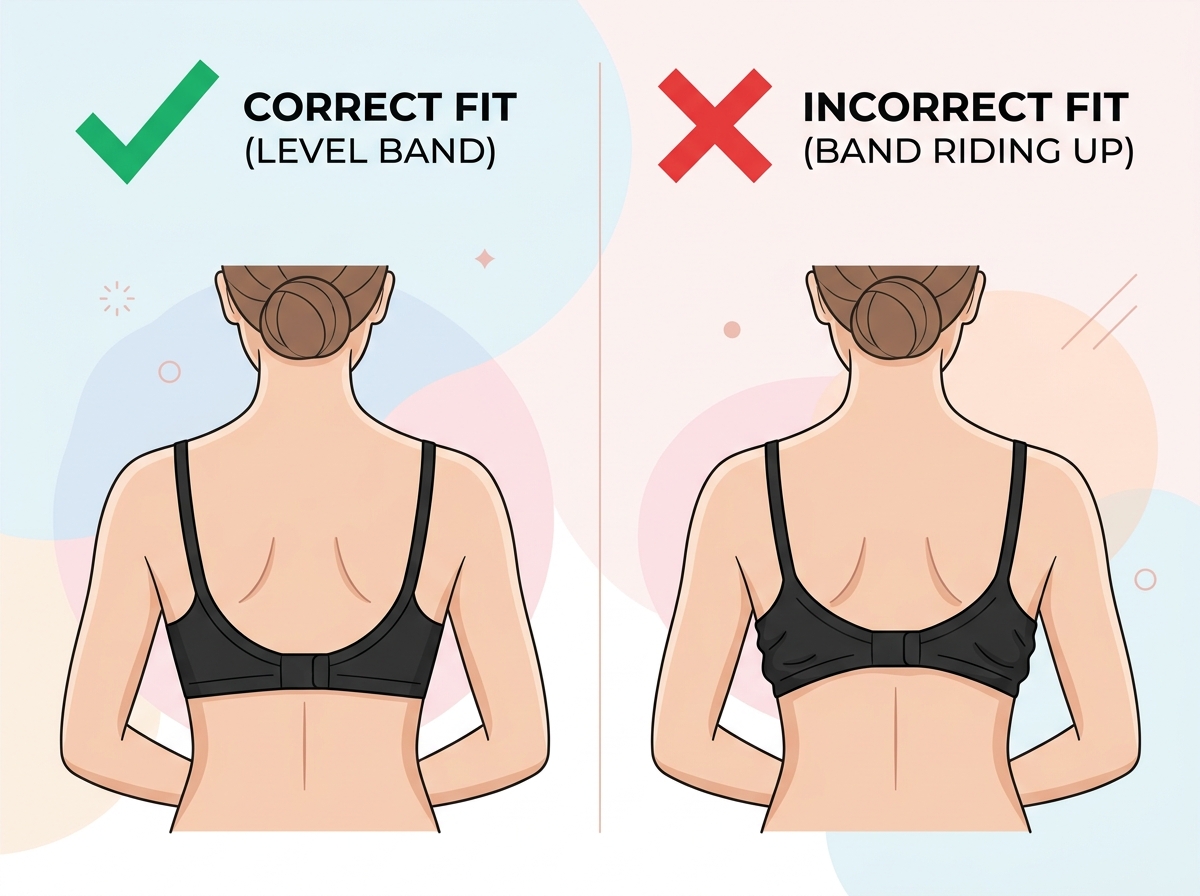
Before abandoning the brand entirely, try going up one band size. But—and this is critical—remember to go down one cup size to maintain the exact same cup volume (e.g., if a 34D is too agonizingly tight around your ribs, you need to try a 36C). If you just went up to a 36D, the cups would become significantly larger and likely gape.
- 2If the cups are gaping at the top:
First, ensure you have properly "scooped and swooped" all of your breast tissue from under your arms and along your ribcage fully into the cups. If you've done this vigorously and the fabric still gapes, wrinkles, or sags, the cups are simply too large for your breast shape in this specific brand. Try going down one cup size while keeping the band the same (e.g., move from a 34D to a 34C).
- 3If the underwire sits directly on your breast tissue:
This is a major red flag and incredibly uncomfortable. The underwire should encase your breast tissue completely and lay perfectly flat against your sternum (the gore). If it's resting on breast tissue on the sides (under your arms), or floating away from your chest in the middle, the cups are definitively too small. You need a larger cup volume immediately (e.g., scale up from a 34D to a 34DD or 34E).
Understanding how to rapidly and accurately adjust your size based on how the bra actually feels on your unique body is incredibly empowering. This core concept is known in the lingerie industry as "sister sizing," and it is an absolute game-changer for online shopping. For a much deeper, comprehensive dive into this technique, we highly recommend using our dedicated Sister Size Calculator to instantly see all of your adjacent, mathematically equivalent sizes. It can literally save you hundreds of dollars in return shipping fees.
4. Essential Bra Sizing Tools to Continue Your Journey
Still exploring your perfect fit? We've built a comprehensive suite of tools to help you along every single step of your journey. Return to our main hubs to continue exploring and finding that perfect match.
Frequently Asked Questions
How do I convert my bra size between US and UK sizing?
For band sizes, US and UK numbers are 100% identical (30, 32, 34, 36, 38). For cup sizes, US and UK match up to D cup. For cups larger than D, UK uses double-letter progression (DD, E, F, FF, G, GG) while US uses single letters or multi-D notation (DD, DDD, G, H, I).
How do I convert a US/UK bra band size to European (EU) sizing?
To convert a US/UK inch band to EU metric band, multiply the inch band by 2.54 and round to the nearest multiple of 5 cm (e.g. 30 in = 65 EU, 32 in = 70 EU, 34 in = 75 EU, 36 in = 80 EU, 38 in = 85 EU).
Is my bra size the same in every brand?
Unfortunately, no. While international sizing systems provide a fantastic baseline, individual brands often have their own unique fit models. A 34C in a US brand might feel slightly different than a 34C in another US brand due to fabric stretch, cup shape, and intended style. Always use conversion charts as a starting point, but listen to how the bra actually feels on your body.
What if my converted size still doesn't fit right?
If you've converted your size but the bra still feels uncomfortable, you might need to explore 'sister sizes'. If the band is too tight but the cup fits, go up a band size and down a cup size (e.g., from 34C to 36B). If the band is too loose, go down a band size and up a cup size (e.g., from 34C to 32D). Fit is a personal journey, and sister sizing is a powerful tool.
Do French and EU sizes use the same cup letters?
Yes, generally speaking, French (FR) and European (EU) sizing systems use the exact same single-letter cup progression (A, B, C, D, E, F...). The main difference between FR and EU sizing lies in the band numbers. French band sizes are typically exactly 15 higher than the corresponding standard EU band size (e.g., a 75 EU band is a 90 FR band).
Why do UK brands use double letters like FF and GG?
The UK sizing system is renowned for its precision, particularly in larger cup sizes. Instead of just progressing through the alphabet, they introduce double letters (DD, FF, GG, HH) to denote half-step increments in cup volume. This allows for a much more customized and supportive fit for those who need it, compared to systems that only use single letters.
What should I do if a brand doesn't specify which sizing system they use?
If a brand is ambiguous about its sizing (which happens all too frequently!), check their size chart carefully. Look at the progression of cups. If you see 'DD, E, F, FF, G', you are dealing with UK sizing. If you see 'DD, DDD, G, H', it is US sizing. If you only see single letters 'D, E, F, G', it's likely EU sizing. Knowing these telltale signs is your best defense against mis-ordering.
Why is my band size a completely different number in Australia?
Unlike the US or UK which use inches for underbust measurement (e.g., 34), Australian and New Zealand bra bands are aligned with their standard dress sizes (e.g., 8, 10, 12, 14). So, a US 34 band equates to an AU 12. Their cup sizes, however, closely follow the UK system up to a certain point.