
Sister sizes are bra size combinations that maintain identical volumetric breast cup capacity while adjusting the underbust band's tightness. Select your current size below to generate your exact tighter-band and looser-band sister sizes, and finally achieve the comfort and support you deserve.
Sister Size Calculator & Equivalent Cup Volume Generator
Welcome to the ultimate tool for solving your most persistent bra fit frustrations. If you have ever found a bra where the cups fit your breasts like an absolute dream, but the band is painfully digging into your ribs or annoyingly sliding up your back, sister sizes are your secret weapon.
The Deep Emotional and Physical Reality of Bra Fitting
Let’s take a moment to deeply acknowledge the physical and emotional toll that an ill-fitting bra takes on your daily life. For far too long, the lingerie industry has normalized pain. We are taught to expect that the moment we walk through our front door, the first thing we must do is unhook our bra to finally breathe. We are told that beauty is pain, that red marks are normal, and that shoulder grooves are just a part of having breasts. But let us be unequivocally clear: this is a systemic failure of garment manufacturing, not a flaw in your beautiful, natural body.
The sheer exhaustion of dealing with underwires that dig into your sensitive breast tissue, bands that ride up and offer zero support, and straps that mercilessly slice into your trapezius muscles is profound. This isn't just about fashion; it's about your medical and physical well-being. When a bra fails to support you properly, your body is forced to compensate. Your shoulders hunch forward, trying to alleviate the downward pull on the straps. Your neck muscles tighten, leading to chronic tension headaches and upper back spasms. This constant, low-grade physical stress drains your energy and distracts you from living your life fully.
You might have stood in a harshly lit department store dressing room, trying on a dozen different bras in the size you were 'told' you are, only to find that every single one pinches, gaps, or spills over. The psychological impact of this experience is often one of deep inadequacy. You might look in the mirror and wonder, 'Why doesn't my body look like the mannequins? What is wrong with my shape?' The answer is absolutely nothing. The bra industry uses incredibly limited, statistically average fit models that fail to represent the immense, beautiful diversity of human breast shapes, root widths, and tissue densities.
It is time to radically shift our perspective. A bra should be an article of clothing that serves you, not a cage that you must endure. It should be a masterpiece of engineering that lifts, supports, and seamlessly integrates with your unique anatomy. Finding that perfect fit is an act of radical self-care. It is a declaration that you refuse to accept pain as a baseline condition of your daily existence. When you finally find a bra that genuinely fits—a band that anchors securely around your ribcage without suffocating you, cups that perfectly encapsulate your breast tissue without spilling or gaping, and straps that simply rest gently on your shoulders—the relief is instantaneous and profound. You stand taller. Your silhouette changes. The chronic pain in your shoulders begins to melt away. You can finally breathe, move, and exist in the world without the constant, nagging distraction of a garment actively hurting you.
We want you to embark on this fitting journey with immense self-compassion. Throw away the arbitrary numbers and letters that have caused you so much frustration. Approach this process as a scientific exploration of your own body. Learn about your shape, understand your roots, and demand garments that meet your precise needs. You deserve comfort. You deserve support. And you absolutely deserve a bra that makes you feel powerful, capable, and pain-free every single day. Always remember to check our How to Measure and Fit Guide for more help.
Sister Size Calculator Form
SISTER SIZES BREAKDOWN
Sister Sizes for 34C
Smaller Band ←
32D
If band feels too loose: Try a smaller band size with a larger cup letter.
Current Size
Your Baseline
34C
Starting baseline size entered above.
→ Larger Band
36B
If band feels too tight: Try a larger band size with a smaller cup letter.
The Emotional and Physical Toll of a Bad Bra Fit
We intimately understand the silent, daily struggle of wearing an ill-fitting bra. It typically begins early in the morning—you put on what looks like a beautiful, supportive piece of lingerie, hoping today will be different. But by lunchtime, you are discreetly tugging at a band that refuses to stay in place, or wincing as rigid metal underwires relentlessly dig into your sensitive rib tissue. The intense shoulder pain, the glaring red marks left behind at the end of the day, and the sheer frustration of spending your hard-earned money on garments that practically hurt you... it is utterly exhausting. You are not alone in this experience, and more importantly, your body is absolutely not the problem. The traditional lingerie sizing system is simply deeply misunderstood.
Millions of women spend years, sometimes decades, compromising on basic bodily comfort because they mistakenly believe they are permanently bound to a single, static bra size. But human bodies are incredibly dynamic and constantly changing. Weight fluctuations, hormonal shifts throughout the month, pregnancy, aging, and the simple fact that every single lingerie brand uses entirely different manufacturing standards and fit models mean that your "true" size is actually a flexible range of interconnected sizes. This is exactly where the mathematical magic of sister sizing comes in. It empowers you to take complete control of your comfort by making smart, strategic adjustments without losing the cup fit you already love.
Before diving deep into the advanced mechanics of sister sizing, we highly recommend double-checking your current body measurements to ensure you are starting from a solid foundation. Taking just five minutes to accurately measure your full bust and snug underbust with a soft measuring tape can save you months of unnecessary discomfort. We strongly encourage you to check out our comprehensive Step-by-Step Guide on How to Measure Your Bra Size or consult our detailed Ultimate Bra Fit Guide to guarantee you are starting with an accurate, reliable baseline size.
1. The Physics of Equal Cup Volume Conservation
One of the biggest and most pervasive misconceptions in the lingerie industry is that a cup letter represents a fixed, absolute size. Pop culture and society have incorrectly taught us that a "D cup" is universally huge and an "A cup" is universally tiny. In reality, the entire architecture of bra underwires and cups scales proportionally with the length of the underbust band. A cup letter is merely an index of relative ratio—specifically, the difference in inches between your bust measurement and your underbust measurement—rather than an absolute, static volume of breast tissue.
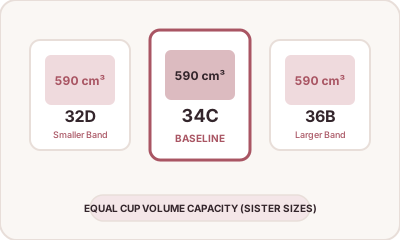 Figure 1: Equal 590 cm³ cup volume capacity across 32D, 34C, and 36B sister sizes
As beautifully illustrated in Figure 1 above, a 32D, 34C, and 36B bra cup all hold the exact same volumetric displacement (approximately 590 cc). The only structural difference between these three very different-sounding bras is the length of the elastic underbust band that anchors the garment around your ribcage! A 32D is carefully designed for a significantly smaller ribcage, while a 36B is meant for a much broader ribcage, yet both garments accommodate the exact same volume of breast tissue perfectly. Understanding this proportional scaling is the ultimate key to unlocking a lifetime of perfectly fitting, deeply comfortable bras.
When you adjust the band size for comfort, you must perform the mathematical inverse to the cup letter to maintain that same perfect breast volume. If you lengthen the band (go up a band size to relieve pressure), you are essentially pulling the cups wider apart across your chest; to compensate for this extra width and keep the actual cup volume identical, you must drop down one cup letter. Conversely, if you shorten the band (go down a band size to increase support), the cups are pulled closer together; to retain the required volume capacity, you must increase the cup letter. It is a perfect, balancing equation of comfort and support.
2. Master Sister Size Cross-Reference Matrix
To make visualizing this easier, we have compiled a master reference chart. Use this highly detailed reference table to find equivalent volume rows across common band sizes. If you find your current size anywhere in a horizontal row, every other size in that exact same row will hold the same cup volume, just on a differently sized band.
| Volume Group | 30 Band Sister | 32 Band Sister | 34 Band Sister | 36 Band Sister | 38 Band Sister |
|---|---|---|---|---|---|
| ~390 cc Volume | 30D | 32C | 34B | 36A | 38AA |
| ~480 cc Volume | 30DD | 32D | 34C | 36B | 38A |
| ~590 cc Volume | 30E | 32DD | 34D | 36C | 38B |
| ~710 cc Volume | 30F | 32E | 34DD | 36D | 38C |
3. When You Should Absolutely Use Sister Sizing
Sister sizing is not a magic cure-all for every bra fit problem, but it is the perfect, elegant solution for specific issues. Here are the most common real-world scenarios where sister sizing will completely transform your bra-wearing experience and eliminate pain.
Scenario 1: The Band Constantly Rides Up Your Back
If your cups fit beautifully and encapsulate your breasts without spilling or gaping, but the band consistently slides up between your shoulder blades throughout the day, the band is far too loose. The band should sit perfectly parallel to the floor, firmly anchored around your ribs to provide 80% of the bra's overall support. To fix this frustrating issue, you must move to the smaller band sister size. For example, if you are wearing a 36C, try shifting down to a 34D. You gain a tighter, far more secure anchor around your ribcage without sacrificing a single millimeter of the cup volume you love.
Scenario 2: The Underwire Digs In Painfully
Conversely, if your cups beautifully contain your breast tissue, but the band feels agonizingly tight, restricts your deep breathing, or the underwires aggressively dig into your sensitive ribcage, your band is too small. A properly fitting band should be snug but never painful. To gain crucial breathing room and alleviate the pressure on your ribs, you must move to the larger band sister size. For instance, if you are wearing a 34C and feel restricted, try shifting up to a 36B. You will immediately gain ribcage room and relief while preserving the exact same cup fit.
Scenario 3: Shopping Across Different Brands and Fabrics
Every bra manufacturer utilizes entirely different fit models, grading algorithms, and fabric elasticity. A stretchy lace band in a 34C from a luxury European brand might feel incredibly loose compared to a firm, rigid sports bra band in a 34C from an athletic brand. Knowing your sister sizes (32D and 36B) allows you to seamlessly confidently navigate different brands and fabric types without returning to square one in the fitting room.
4. When NOT to Rely on Sister Sizing
While sister sizing is incredibly powerful, it is crucial to understand its limitations. If you jump more than one size away from your true baseline size (for example, moving from a 34C all the way down to a 30DD), the physical dimensions and structural geometry of the bra begin to warp. The cups might end up placed too close together on the front of the bra, or the underwires might become too wide, wrapping uncomfortably under your armpits. Always try to stay within one sister size of your true measurement.
Furthermore, if your cups are gaping open, or if you are spilling heavily over the top of the cups (the dreaded "quad-boob" effect), sister sizing will not help you. Sister sizing assumes your current cups fit perfectly. If the cups themselves are the wrong size, you need to recalculate your baseline entirely. Please visit our Ultimate Fit Guide to troubleshoot fundamental sizing mismatches.
5. Explore More Precision Sizing Tools
Frequently Asked Questions About Sister Sizing
Can a poorly fitting bra cause permanent changes to my body?↓
Yes. Long-term wear of a bra with a loose band and tight straps can cause permanent grooving in the shoulder tissue and contribute to chronic postural issues like kyphosis (hunched back). Wires resting on breast tissue can also cause painful tissue migration over time.
Why do I feel so much better in a sports bra than a regular bra?↓
Sports bras often rely on compression and a very firm band to eliminate bounce. If you find them drastically more comfortable than everyday bras, it's a huge indicator that your everyday bras have bands that are much too loose, failing to provide the firm anchorage your ribcage craves.
What are sister sizes in bra fitting?↓
Sister sizes are bra size combinations that share the exact same physical cup volume capacity despite having different band measurements. For example, 32D, 34C, 36B, and 38A all hold the exact same volumetric displacement of breast tissue (approx 590 cc).
How do I calculate my sister size?↓
To find your sister size for a tighter band: go down 1 band size and UP 1 cup letter (e.g. 34C -> 32D). To find your sister size for a looser band: go up 1 band size and DOWN 1 cup letter (e.g. 34C -> 36B).
Why does my bra band ride up my back, and which sister size fixes it?↓
A band that rides up your back is almost always too loose, failing to provide the necessary support. To fix this, you should try a sister size with a smaller band and a larger cup letter. For instance, if you wear a 36C and the band rides up, try a 34D to secure the band around your ribcage without losing any cup volume.
My underwire digs into my ribs painfully. Should I try a sister size?↓
Yes, digging underwires are a classic sign that your bra band is too tight or the cup is too small. If the cups fit well but the band is agonizing, you should sister size up in the band and down in the cup (e.g., swapping a 32DD for a 34D). This gives your ribs breathing room while maintaining the exact same cup capacity.
Do sister sizes have the exact same wire width and cup depth?↓
While sister sizes contain the same total breast volume, the exact shape of the cups can vary slightly. A smaller band sister size may feature slightly narrower and deeper cups, whereas a larger band sister size might have slightly wider and shallower cups. However, for most people moving just one sister size away, the difference is negligible.
Can I go up or down more than one sister size?↓
It is generally not recommended to jump more than one sister size in either direction. For example, moving from a 34C to a 32D is fine, but jumping to a 30DD alters the structural proportions of the bra too drastically. The cups may sit too far apart or too close together, compromising support and comfort.
How do I know if I need a sister size instead of a completely new bra size?↓
You need a sister size if your current cups fit perfectly (no spilling, gaping, or wrinkling) but the band is either too loose or too tight. If both the band and the cups fit poorly, or if you are spilling out of the cups while the band feels fine, you likely need a completely new bra size, not a sister size.
Are sister sizes the same across different bra brands?↓
The mathematical concept of sister sizing remains consistent across all bra brands. However, because different brands use different grading rules, fabrics, and fit models, a 34C in one brand might feel tighter or looser than a 34C in another. It is always wise to measure yourself and check brand-specific size charts.