
Why Do My Bra Cups Gap? Shape & Volume Master Analysis
Empty space, puckering, or wrinkling at the top edge of your bra cups is one of the most common and confusing fitting problems. Many assume gaping automatically means their cups are too big, but it is frequently caused by cup shape mismatches, underwires that are too narrow, or incorrect sizing metrics. Let's delve deep into the biomechanics of bra fit to solve this frustrating issue once and for all.
When you look in the mirror and see empty space at the top of your bra, the intuitive reaction is to assume your breasts aren't large enough to fill the cup. This assumption leads countless individuals to size down their cups, only to find the new bra still gapes, yet now the underwires dig painfully into their side tissue.
This cycle of frustration is a direct result of misunderstanding how bra construction interacts with human anatomy. Cup gaping is rarely a simple issue of lacking volume. More often, it is a complex interaction of breast shape, root height, band tension, and fabric rigidity.
1. The "Orange in a Glass" Effect Explained
Imagine trying to push an orange into a tall, narrow drinking glass. Because the orange is wider than the glass opening, it gets stuck near the top, leaving a completely empty air gap at the bottom of the glass. No matter how hard you push, the orange cannot reach the bottom because the structural dimensions are incompatible.
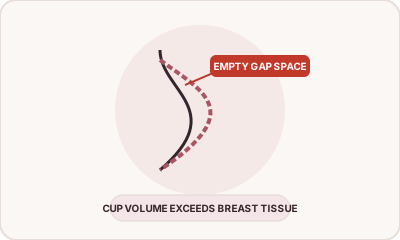 Figure 1: Empty gap space caused by stiff moulded cup contours
In bra mechanics, this exact physical phenomenon occurs when a bra's underwire is too narrow for your breast root (the area where your breast tissue attaches to your chest wall). If your breast root is wide but the underwire is shaped like a narrow 'U', your breast tissue cannot physically enter the deepest part of the cup base.
Instead, your breast tissue sits outside the underwire arch, effectively pushing the entire cup away from your body. Because the cup is being pushed outward, the top edge tilts away from your chest, causing severe gaping—even though the cup volume is actually too small to encapsulate your tissue. Understanding your breast root width is a fundamental component of bra fitting that goes far beyond simple tape measurements.
2. The Core Biomechanical Causes of Cup Gaping
Beyond narrow underwires, there are several other primary mechanisms that cause bra cups to gape. Identifying which of these applies to your body is the first step toward finding a flawless fit.
The Moulded Foam Stiff Shape (Shape Mismatch)
The vast majority of modern bras sold in department stores are "t-shirt bras" constructed from moulded foam. These bras are manufactured by heat-pressing synthetic foam over a fixed metal dome. Consequently, the cup holds its own rigid shape whether it is on or off your body. If your natural breast tissue does not exactly match the shape of that pre-formed dome, the bra will gape. Breasts are soft tissue and dynamic; they are rarely perfect spheres. If you have "bottom-heavy" breasts, you will not have enough upper-pole fullness to fill out the top curve, resulting in empty space.
The Fix: Transition away from rigid foam and embrace unlined, cut-and-sewn (seamed) bras, particularly those featuring stretch lace on the upper panels.
Short Breast Root Height
Breast root height refers to how tall your breast tissue sits on your chest wall, from the inframammary fold up towards your collarbone. Individuals with short roots have breast tissue that ends relatively low on the chest. Full-coverage bras are designed with tall cups meant to encapsulate tall breast roots. If you have short roots and wear a full-coverage style, the top half of the cup will simply cover empty chest space.
The Fix: Opt for balconette, demi-cup, or half-cup styles. These cuts feature shorter cup heights engineered to lift without demanding tall upper-pole tissue.
Inadequate Band Tension
The bra band is the foundation of the garment's structural integrity. A properly fitted band should provide 80% to 90% of the support. If your band is too loose, the back of the bra will ride up your spine. When the back rides up, the front inevitably tilts forward and down, pulling the bra cups away from your chest wall and instantly creating a gaping void at the top edge.
The Fix: Recalculate your band size. Your band size should roughly equal your snug underbust measurement in inches.
Quick Diagnostic Matrix
| Diagnostic Cause | Physical Mechanism | Corrective Fix |
|---|---|---|
| Moulded Foam Stiff Shape | Pre-formed synthetic dome does not adapt to soft tissue or shallow upper roots. | Switch to unlined 3-part seamed stretch lace cups (balconette). |
| Excess Cup Volume | Overbust measurement was overestimated; cup capacity exceeds bust volume. | Decrease cup size by 1 letter (e.g. 34D → 34C). |
| Short Breast Root Height | Full-coverage cups are too tall for short torso distance between IMF and collarbone. | Choose demi cups or low-apex plunge cuts. |
3. The Mandatory 30-Second Scoop and Swoop Protocol
Before diagnosing any fit issue or deciding a bra cup is too large, you must perform the mandatory fitting maneuver known as the "Scoop and Swoop." When you put a bra on like a t-shirt, gravity and everyday movement cause breast tissue to settle backward toward your underarms and side ribcage.
- The Lean: Lean forward from your waist at a 45-degree angle so gravity pulls breast tissue into the cups.
- The Scoop: Reach inside the left cup with your right hand. Gently but firmly scoop your breast tissue from under your arm and side ribcage, including the axillary tail.
- The Swoop: Pull that scooped tissue forward and up into the center of the cup. Adjust the underwire so it rests flush inside your inframammary fold.
- The Assessment: Repeat for the right side, stand up straight, and check the cup top. In 50% of cases, gaping disappears instantly!
If you swoop and suddenly spill out of the top of the cup, it confirms that your cup size is actually too small, not too big. This simple biomechanical adjustment is critical for accurate fitting.
4. The Emotional and Physical Toll of Hollow Cups
Few fitting issues trigger as much self-doubt as cup gaping. When a bra cup bunches, ripples, or collapses away from your chest wall under your favorite fitted T-shirt, it creates an intensely frustrating silhouette. You find yourself constantly pulling up your neckline or checking in the mirror to see if your bra is noticeably visible through your clothing.
The fast-fashion lingerie industry has trained people to respond to gaping by either sizing down into painful, suffocating underwires or purchasing heavy push-up pads that artificially displace soft tissue. Both responses are band-aids that ignore the underlying structural reality.
When a cup gapes because of root height or projection mismatches, forcing yourself into a smaller cup size causes the underwire to sit directly on your delicate breast tissue laterally. Over months, this constant mechanical pressure can cause micro-trauma to the Cooper's ligaments and breast tissue, creating tender spots near the chest wall while failing to resolve the gaping.
Discovering your true breast shape—and pairing it with an unlined balconette or shallow-friendly demi cut—instantly transforms how clothing sits on your torso. You eliminate the hollow air pocket, achieve natural forward lift, and finally experience a bra that contours seamlessly to your living body.
5. The Long-Term Impact of Ignoring Fit Issues
In addition to the immediate physical pain of straps falling down or underwires digging into sensitive breast tissue, the long-term musculoskeletal impact is undeniable. When you settle for the restrictive 'standard sizing matrix' sold in massive retail chains, you force your body into a mold it was never meant to fit. This compression alters how you breathe, limits your chest expansion during aerobic activities, and even changes the way your clothes drape over your silhouette.
Consider the engineering of a suspension bridge. The support cables must be tensioned perfectly to carry the load. If the main anchors (your bra band) are loose, the secondary cables (your shoulder straps) take on forces they were never designed to handle.
We urge you to take your measurements using our rigorous, unpadded calculators and finally experience what a properly engineered garment feels like. Your body deserves the mathematical accuracy of a custom fit, not a generic retail approximation. Resolving cup gaping is an investment in your daily comfort, your posture, and your overall confidence.
6. Re-Calculate Your Correct Cup Size
Ready to find a fit that actually respects your biomechanics? Use our precision calculators below to determine your mathematically accurate bra size and discover sister sizes that can solve cup gaping once and for all.
Frequently Asked Questions
Why do my bra cups gap at the top even though my calculated size matches?↓
Cup gaping is frequently caused by a mismatch in cup shape rather than volume. Rigid, moulded foam t-shirt cups hold a fixed synthetic dome shape that gapes on teardrop or bottom-heavy breasts. Additionally, the 'Orange in a Glass' effect occurs when underwires are too narrow, preventing breast tissue from settling into the cup base and leaving empty space at the top.
What is the Scoop and Swoop technique?↓
The Scoop and Swoop is an essential bra fitting step: lean forward at 45 degrees, reach your opposite hand inside the cup, and pull all breast tissue forward from under your arm and side ribcage into the center of the cup. This ensures the underwire sits flush in your inframammary fold and often eliminates cup gaping instantly.
Does cup gaping always mean my bra is too big?↓
No, cup gaping does not always mean your bra is too big. In many cases, gaping happens because the cup is too small or the wrong shape. If the cup is too small, your breast tissue might push the cup away from your body, causing the top edge to gap. Similarly, if the band is too loose, the bra will tilt forward, creating a gap.
Why does my bra gap only on one side?↓
Almost all women have some degree of breast asymmetry, where one breast is larger than the other. If you fit your bra to the smaller breast, the larger one will spill over. If you fit to the larger breast, the smaller one may gap. The expert recommendation is always to fit the bra to your larger breast and use a removable insert or tighten the strap slightly on the smaller side to fix the gaping.
What bra styles are best to prevent cup gaping?↓
To prevent cup gaping, avoid stiff moulded t-shirt bras. Instead, opt for unlined bras with seams, particularly those with stretch lace on the top panel. Balconette, demi, and plunge styles are generally better for avoiding top gaping because they have shorter cup heights compared to full-coverage styles.