
Bra Size Calculator & Tips for Sagging Breasts
Stop Guessing Your Size
Use our international bra size calculator to find your perfect fit in seconds.
Introduction: Embracing Your Natural Shape
Gravity is a natural force, and its effects on the human body are completely normal and universal. For many women, this means that over time, their breasts may begin to droop or sag—a perfectly natural progression that is formally known as breast ptosis. If you have what the bra-fitting community affectionately calls “pendulous” or sagging breasts, you are in excellent company. It is one of the most common breast shapes in the world.
However, having pendulous breasts can make finding a bra that fits perfectly feel like an uphill battle. You might find that your breasts pool at the bottom of the cups, leaving empty space at the top, or that your underwires constantly dig into your ribs. You might have tried entering your measurements into a basic bra size calculator only to end up with a bra that doesn’t fit your body at all.
This happens because standard measurement techniques are inherently flawed when it comes to sagging breasts. They often underestimate the true volume of breast tissue because they only account for the tissue as it hangs, rather than its full volume when properly supported. In this comprehensive pillar guide, we will break down exactly how to measure for sagging breasts, why the leaning measurement is your best friend, the most supportive bra styles for pendulous shapes, and how to use our Bra Size Calculator to finally achieve the lift, support, and comfort you deserve.
Understanding Pendulous Breasts (Breast Ptosis)
Before diving into measurements and calculations, it’s important to understand what we mean when we talk about sagging or pendulous breasts. In medical terms, sagging is referred to as breast ptosis. A breast is considered pendulous when the bulk of the breast tissue hangs below the inframammary fold (IMF)—the crease where the underside of your breast meets your chest wall.
Why Do Breasts Sag?
There are numerous reasons why breasts develop a pendulous shape, and nearly all of them are entirely natural and unavoidable. Some of the most common factors include:
- Genetics: Just as your genetics determine your height or eye color, they also play a massive role in the elasticity of your skin and the density of your breast tissue. Some people naturally have softer, less dense tissue that is more prone to a pendulous shape from a young age.
- Age: As we age, the Cooper’s ligaments (the connective tissue that helps support the breasts) naturally stretch out. Skin also loses its elasticity due to a decrease in collagen and elastin production, leading to a softer, lower-hanging shape.
- Weight Fluctuations: Significant weight gain and weight loss can stretch the skin around the breasts. When weight is lost, the skin may not fully retract, leaving the breast tissue with less tight skin to hold it up.
- Pregnancy and Breastfeeding: During pregnancy, hormonal changes cause the milk ducts to expand, often resulting in larger, heavier breasts. This rapid expansion can stretch the skin and ligaments. After pregnancy or breastfeeding, when the breasts return to a smaller size, they often have a more pendulous shape.
- Hormonal Changes: Menopause causes a drop in estrogen levels, which can lead to a reduction in breast gland tissue. This tissue is often replaced by fat, which is softer and more prone to sagging.
- Gravity and Size: Naturally larger, heavier breasts are subjected to a greater downward pull from gravity over a lifetime, making them more likely to become pendulous compared to smaller breasts.
The most important thing to remember is that sagging breasts are normal. You do not need to “fix” your body; you simply need a bra that is engineered to support your specific shape.
Why Standard Bra Calculators Fail for Sagging Breasts
If you have pendulous breasts, you have likely experienced the frustration of using a standard bra size calculator. The typical formula asks you to take two measurements: your snug underbust and your standing bust (measured around the fullest part of your breasts while standing up straight).
Here is why this standard method fails women with sagging breasts:
When you stand up straight, gravity pulls pendulous breast tissue downward. If you measure around your breasts in this standing position, the measuring tape is capturing a circumference that does not accurately reflect the full volume of your breast tissue. Because the tissue is hanging down, the standing bust measurement will almost always be smaller than your actual breast volume.
When a calculator uses this falsely small bust measurement, it calculates a cup size that is too small for you. For example, your standing measurement might suggest you are a 36D, but because your breast tissue is pendulous, your actual volume might require a 36F. If you try to wear the 36D, you will experience spillage, digging wires, and a lack of support.
To get an accurate result for sagging breasts, you need a more advanced calculation method that captures the true volume of your tissue. This is where the multi-measurement method, and specifically the leaning bust measurement, comes into play.
The Secret Weapon: The Leaning Measurement Technique
To accurately determine your bra size when you have pendulous breasts, you must measure the breast tissue when it is fully suspended, rather than when it is compressed against your chest or hanging downward. The most effective way to do this is by taking a leaning bust measurement.
The leaning measurement allows gravity to pull all of your breast tissue forward, simulating the shape and volume your breasts will have when they are fully supported in a well-fitting bra. For women with sagging breasts, the leaning measurement is often significantly larger than the standing measurement—sometimes by several inches!
How to Take the Leaning Bust Measurement
- Strip Down: Remove your bra and shirt. For the most accurate results, you should measure against your bare skin.
- Bend Over: Bend forward at a 90-degree angle at the waist, so your back is parallel to the floor. Allow your breasts to hang completely freely.
- Position the Tape: Take your soft measuring tape and wrap it around your torso, over the absolute fullest part of your hanging breasts (usually right over the nipples).
- Keep it Loose: The tape should lightly rest on your skin. Do not pull it tight or allow it to compress or indent your breast tissue in any way. Make sure the tape is straight across your back and not twisted.
- Record the Number: Note down the measurement in inches or centimeters.
The Lying Down Measurement
For an even more precise calculation, advanced bra size calculators (like the one we recommend) also ask for a lying down bust measurement.
- Lie flat on your back on a firm surface, like the floor or a firm mattress.
- Allow your breast tissue to spread out naturally across your chest.
- Wrap the measuring tape around the fullest part of your breasts.
- Ensure the tape is level and not indenting the tissue. Record this number.
By factoring in your standing, leaning, and lying bust measurements, an advanced calculator can average these numbers out to give you a highly accurate estimate of your true cup volume, completely negating the issues caused by standard two-measurement calculators.
Step-by-Step Guide: How to Use Our Bra Size Calculator for Sagging Breasts
To get the most accurate baseline size for your pendulous breasts, you need to use a calculator that requires six distinct measurements. Here is a step-by-step guide to gathering the data you need for our Bra Size Calculator.
Phase 1: The Underbust Measurements
Your underbust measurements determine your band size. Because the band provides 80% of a bra’s support, getting this right is critical for lifting sagging breasts.
- Loose Underbust: Wrap the tape around your ribcage, directly underneath your breasts where the bra band would sit. The tape should be level and just barely resting against your skin, without digging in at all. Take a deep breath in and record this measurement.
- Snug Underbust: Wrap the tape around the exact same spot. This time, pull it comfortably snug—about as tight as you would want a brand-new bra band to feel on its loosest set of hooks. Exhale to a neutral position and record this measurement.
- Tight (Break-the-Tape) Underbust: Exhale all the air from your lungs. Wrap the tape around your underbust and pull it as physically tight as you possibly can, as if you are trying to break the tape. This tells the calculator the absolute minimum size of your ribcage, ensuring it doesn’t recommend a band that is larger than your skeletal structure. Record this measurement.
Phase 2: The Bust Measurements
These measurements determine your cup volume.
- Standing Bust: Stand up straight and relaxed. Wrap the tape around the fullest part of your breasts loosely, without indenting the tissue. Record this measurement.
- Leaning Bust: Bend forward at a 90-degree angle. Wrap the tape around the fullest part of your hanging breasts loosely. Record this measurement. (This is the most important number for pendulous breasts!).
- Lying Bust: Lie flat on your back and wrap the tape around the fullest part of your breasts loosely. Record this measurement.
Phase 3: The Calculation
Input all six of these measurements into our advanced Bra Size Calculator. The algorithm will analyze the difference between your standing, leaning, and lying measurements to determine your actual breast volume, providing you with a highly accurate starting size.
Remember, if your new size seems shocking (for example, if you’ve been wearing a 38C and the calculator suggests a 34G), do not panic! This phenomenon, known as “sticker shock,” is incredibly common. Trust the measurements and give the new size a try.
Best Bra Styles for Sagging Breasts
Knowing your correct size is only half the battle. When you have pendulous breasts, the style and construction of the bra are just as important as the size. Sagging breast tissue is often very soft and malleable, meaning it will take on the shape of whatever container you put it in.
If you put soft, pendulous tissue into a stiff, pre-molded bra, the tissue will pool at the bottom, leaving empty space at the top. To get lift, projection, and support, you need bras that are structurally engineered to lift the tissue up and bring it forward.
Here are the absolute best bra styles for sagging breasts:
1. Unlined, Seamed Bras (Cut-and-Sewn Bras)
If there is one golden rule for pendulous breasts, it is this: Ditch the seamless, molded foam t-shirt bras.
Instead, opt for unlined bras made of fabric that has been cut into multiple pieces and sewn together (seamed bras). The seams in the cup act as structural support beams. A three-part or four-part seamed cup physically lifts the heavy breast tissue from the bottom and shapes it, rather than just covering it up. Seamed bras conform to your unique shape, providing incredible lift and preventing the gaping at the top of the cup that is so common with molded bras.
2. Balconette (Balcony) Bras
Balconette bras are fantastic for sagging breasts. They feature cups that are cut slightly lower horizontally, with straps that are set wider apart on the shoulders.
The genius of a balconette bra lies in its lower cups, which are designed to lift the breast tissue upward from the bottom, creating a beautiful, rounded shape and enhanced cleavage. Because the cups do not come up as high on the chest, they eliminate the problem of empty space at the top of the cup—a frequent issue for women whose breast tissue is fuller at the bottom (bottom-heavy) due to sagging.
3. Side Support Bras
Pendulous breasts often tend to splay outward toward the underarms, making the chest look wider and making it difficult to keep the tissue contained front-and-center.
Side support bras (often full-cup or balconette styles with an added vertical seam or sling on the outer edge of the cup) are designed specifically to combat this. The side sling acts like a gentle hand, pushing the breast tissue inward from the armpits toward the center of your chest. This not only provides a tremendous amount of lift but also creates a narrower, more projected silhouette.
4. Full Cup Bras (with Stretch Lace)
If you have very soft tissue that tends to spill out of lower-cut bras, a full cup bra offers maximum containment and support. However, to avoid a matronly look or gaping at the top, look for full cup bras that feature stretch lace on the top panel of the cup.
Stretch lace is incredibly forgiving. It hugs the upper portion of your breast tightly, accommodating any lack of upper fullness while safely containing the bottom-heavy tissue. This ensures a smooth line under clothing with zero gaping.
Styles to Avoid
- Molded T-Shirt Bras: As mentioned, pre-formed foam cups expect your breasts to be perfectly round and self-supporting. Pendulous breasts will sink to the bottom, leaving the top of the cup empty and causing the lip of the cup to show through shirts.
- Plunge Bras: Because pendulous tissue is soft, a deep plunge bra often fails to hold the tissue in the center. The soft tissue can easily spill out the middle of the deep V-neckline, causing “quad-boob” in the center of your chest.
Common Fit Issues and How to Solve Them
Even with the correct size and style, you may encounter minor fit issues. Here is how to troubleshoot common problems specific to sagging breasts:
Gaping at the Top of the Cup
The Problem: You have empty space or wrinkling fabric at the top of your bra cups. The Solution: Many women assume gaping means the cup size is too big, so they size down. However, for pendulous breasts, gaping usually means the cup shape is wrong. If you are wearing a molded bra, switch to an unlined seamed bra or a balconette with stretch lace. The gaping happens because your soft tissue is pooling at the bottom of a rigid cup. You need a cup that conforms to your shape, not the other way around.
The Band Rides Up Your Back
The Problem: The back band of your bra creates an inverted “U” shape rather than sitting parallel to the floor. The Solution: Your band is too loose! The band should provide 80% of the bra’s support, carrying the weight of your breasts. If it rides up, the front is being pulled down by the weight of your breasts, offering zero lift. You need to go down a band size. Remember to use our Sister Size concept: if you go down a band size (e.g., 36 to 34), you must go up a cup letter (e.g., D to DD) to keep the same cup volume.
Underwires Digging into the Ribs
The Problem: The underwires painfully dig into your ribcage directly beneath your breasts. The Solution: This usually happens when the cups are too small or too shallow. When your breast tissue cannot fit fully into the cup, it pushes the cup away from your body. Because the bra is anchored at the band, this pushing effect acts as a lever, driving the bottom of the underwires aggressively into your ribs. You likely need to go up a cup size or find a bra style with deeper, more projected cups (like unlined seamed bras).
The Importance of the “Scoop and Swoop”
Finally, no matter how perfect your bra size and style are, they will not lift sagging breasts properly unless you put the bra on correctly. You must use the “Scoop and Swoop” method every single time you put on a bra.
When you just hook a bra and pull the straps up, much of your soft breast tissue gets trapped under the underwire or pushed back toward your armpits.
How to Scoop and Swoop:
- Lean forward slightly.
- Place your opposite hand inside the bra cup, reaching all the way back toward your armpit and back.
- Firmly but gently scoop all the breast tissue forward and upward, swooping it directly into the center of the cup.
- Ensure the underwire is sitting flush against your ribcage, exactly in the inframammary fold (the crease beneath your breast), not resting on any breast tissue.
For pendulous breasts, this technique is transformative. It can take you from looking like your cups are too big to realizing they are actually too small once all the tissue is properly placed!
Conclusion
Finding the perfect bra for sagging breasts doesn’t have to be a miserable experience. By understanding your unique pendulous shape, utilizing the leaning measurement technique, and choosing structurally supportive styles like unlined seamed bras and balconettes, you can achieve incredible lift, comfort, and confidence.
Stop settling for discomfort, gaping cups, and digging wires. Use the link below to calculate your exact size instantly using our advanced multi-measurement tool. Don’t forget to review your results against our international converter charts to ensure a perfect fit no matter what brand you’re buying.
Embrace your natural shape, and give your body the support it deserves!
Frequently Asked Questions
Is the bra size calculator for sagging breast completely free to use?
Yes, our calculator is 100% free, private, and runs entirely on your device without storing your personal measurements.
How often should I re-calculate my size?
We recommend measuring every 6 months or whenever you experience significant weight changes, pregnancy, or changes in hormonal birth control. Breast tissue density and size can fluctuate frequently.
Why does the calculator ask for a leaning measurement?
The leaning measurement is crucial for pendulous or sagging breasts because it allows gravity to pull all the breast tissue forward. This accurately captures your true breast volume, whereas a standing measurement often underestimates it, leading to cup sizes that are too small.
Are molded t-shirt bras good for sagging breasts?
Generally, no. Molded bras have a rigid, pre-formed shape. Because sagging breasts are often made of softer tissue, they tend to pool at the bottom of molded cups, leaving empty space or gaping at the top. Unlined, seamed bras are much better as they conform to and lift your natural shape.
What does it mean if the top of my bra cup gapes, but the underwire digs in?
This is a classic sign of a "shape mismatch" rather than the cup simply being too big. For sagging breasts, this often means the bra cup is too tall and too shallow. The underwire digs in because your breast tissue needs more depth at the bottom of the cup, pushing the wire into your ribs. Try a balconette or a seamed bra with deeper cups.
How can I get lift without wearing a push-up bra?
The majority of the lift in any bra comes from the band, not the cups or straps. Ensuring you are wearing a snug band that stays parallel to the floor will instantly lift your bust. Additionally, seamed cups provide structural lift from the bottom without needing extra padding.
Why Proper Fit Matters
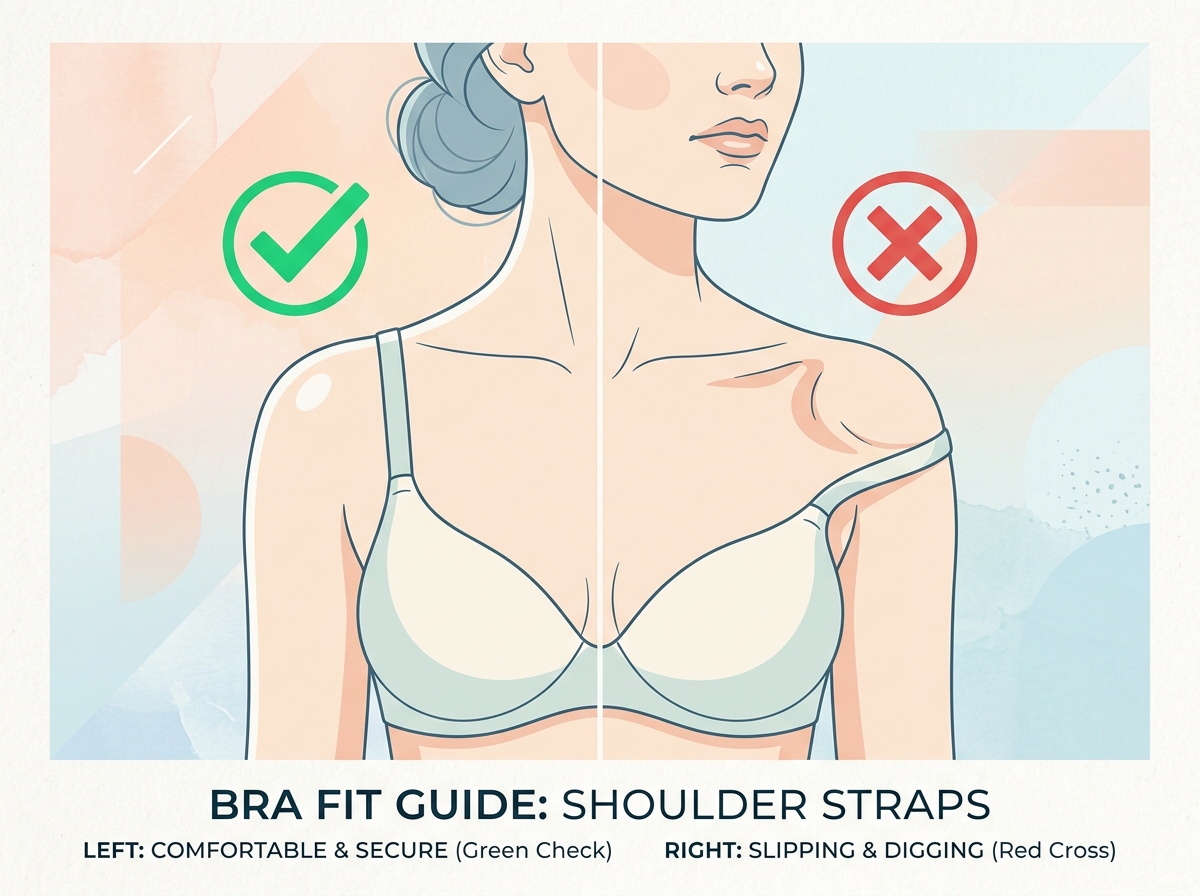
Wearing a bra that fits correctly provides reliable daily support and all-day comfort. A well-fitted band takes the weight off your shoulders, prevents slipping or digging straps, and ensures your garments sit smoothly against your body.
Because body measurements and bra sizing matrices vary across different manufacturers, learning how to measure your bra size accurately is the most dependable way to establish your baseline. If your current bra feels uncomfortable, browse our bra fit diagnostic guide for common solutions.