
Bra Size Calculator & Fit Guide for Trans Women
Stop Guessing Your Size
Use our international bra size calculator to find your perfect fit in seconds.
The Ultimate Bra Size Calculator & Fit Guide for Trans Women
Navigating the world of lingerie can be intimidating for anyone, but for transgender women (MTF) and transfeminine individuals, finding a properly fitting bra comes with its own unique set of physical considerations. Standard bra sizing algorithms were historically built around cisgender body proportions, which often leads to trans women experiencing tight bands, gaping cups, and uncomfortable underwires.
This specialized pillar guide is designed to empower you with the knowledge to measure accurately, understand how Hormone Replacement Therapy (HRT) affects your sizing over time, and choose the best bra styles for a broader chest wall. Our MTF bra size calculator is optimized to help you find your true, comfortable fit.
Anatomical Differences: Why Standard Calculators Sometimes Fail
To find the perfect fit, it is essential to understand how AMAB (Assigned Male at Birth) chest anatomy differs from AFAB (Assigned Female at Birth) anatomy, and why this matters for bra shopping:
- Broader Ribcage and Shoulders: Trans women often have a wider, more V-shaped torso. This means a larger band size is usually required, but the traditional correlation between a large band and a large cup volume doesn’t always apply.
- Wider Breast Root: The “root” is where the breast tissue attaches to the chest wall. Trans women often have a wider breast root, meaning the tissue is spread across a broader area rather than projecting outward. Standard bras with narrow underwires can dig painfully into breast tissue on the sides.
- Shallower Projection: Because the breast tissue is spread over a wider area, the breasts may appear shallower. A standard cup might gap at the apex (the tip) because it is designed for more forward projection.
How to Measure for Your MTF Bra Size
Taking accurate measurements is the first step. You will need a soft, flexible measuring tape and a mirror.
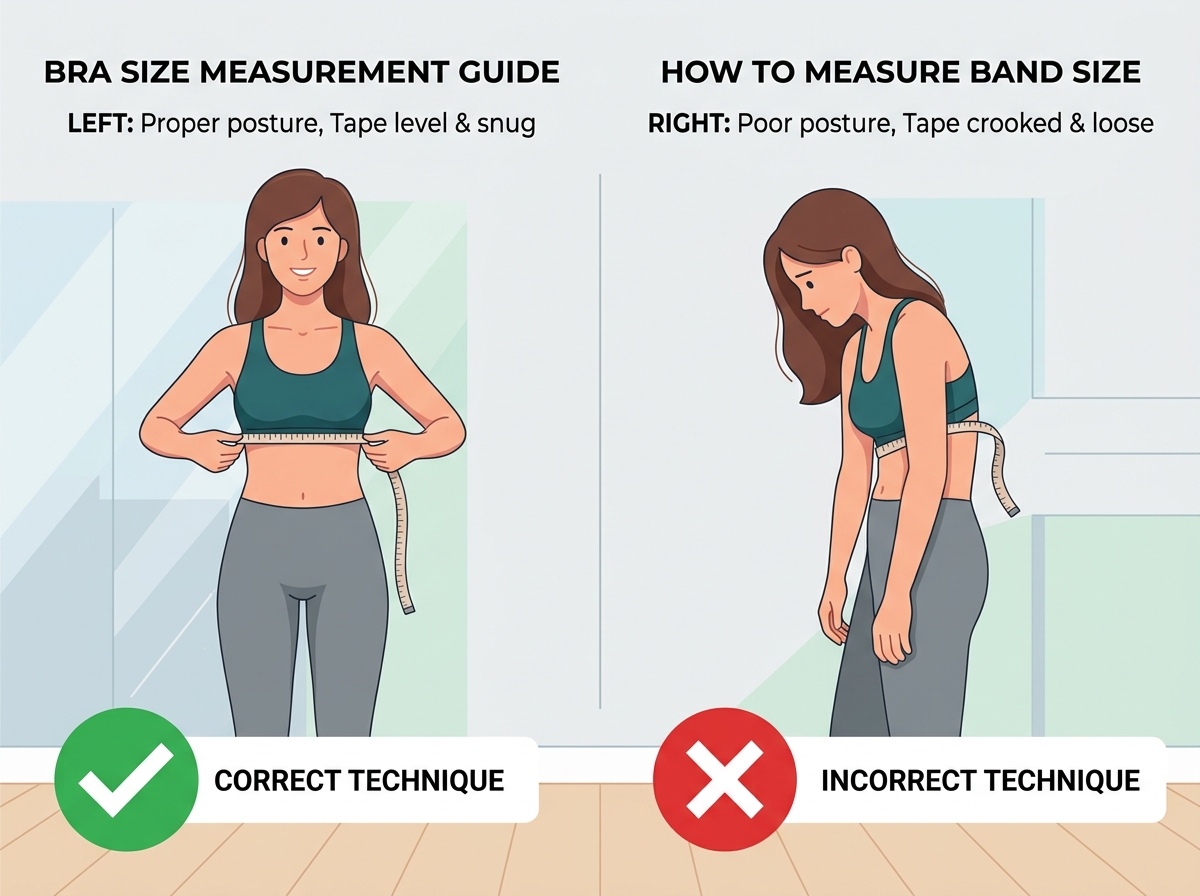
Step 1: The Underbust (Band) Measurement
- Stand straight and wrap the tape around your ribcage, directly under your breasts (or where your breasts will be).
- Ensure the tape is level across your back.
- Pull the tape so it is very snug. Because a broader ribcage has less squishy tissue (adipose tissue) padding the ribs, a loose band will ride up and chafe.
- Write down this measurement. If it is an odd number, standard practice is to round up to the nearest even number (e.g., a 37 becomes a 38 band).
Step 2: The Overbust (Cup) Measurement
- Wrap the tape around the fullest part of your chest.
- Do not pull the tape tight; it should rest lightly against your skin.
- Ensure it remains level across your back. Write this number down.
Step 3: Use the Specialized Calculator
Enter your data into our Bra Size Calculator. While standard calculators take a strict 1-inch difference = 1 cup size approach, many trans women find that going down one cup size from standard calculations provides a better fit due to shallower projection. (For example, if the math suggests a 38C, a 38B might actually fit the breast root better without gaping).
The Best Bra Styles for Trans Women
Because of the wider root and shallower projection, certain bra styles are vastly superior for early transition and beyond:
- Bralettes and Sports Bras: During the first 1-2 years of HRT, your breasts will be highly sensitive and constantly changing shape. Stretchy bralettes are forgiving, comfortable, and adapt to growth without rigid wires.
- Demi or Half-Cup Bras: These bras are cut lower across the top of the cup. If you suffer from “cup gaping” at the top of a full-coverage bra, a demi cup solves this by accommodating shallower projection.
- Plunge Bras: Plunge bras are excellent because they have shorter wires in the center gore (the piece between the breasts), preventing the wires from digging into a broader sternum.
- Front-Closure Bras: Because trans women often have broader shoulders, reaching back to clasp a traditional bra can be difficult or uncomfortable. Front-closure styles offer ease of wear.
- Shallow Cups: Look for brands that explicitly cater to “shallow” breast shapes (Natori and Aerie are historically great mainstream options for this).
The Magic of Sister Sizing
If you find a bra you love but the fit isn’t quite right, you need to understand Sister Sizes. Sister sizing allows you to change the band width while keeping the exact same cup volume.
For trans women, the most common adjustment is needing a wider band without increasing the cup size.
- If you measure as a 36B, but the band is agonizingly tight on your ribs, do not buy a 38B. A 38B has a larger cup volume than a 36B, and it will gap.
- Instead, use the sister sizing rule: Go UP in the band, Go DOWN in the cup.
- The sister size for a 36B is a 38A. It provides the larger band you need for your ribcage, but keeps the cup volume exactly the same.
Navigating HRT and Breast Growth
If you are undergoing HRT, your breast development will occur in stages, much like cisgender puberty.
- 0-6 Months: You will likely experience breast buds (which can be very tender) and slight swelling. A soft, seamless bralette is your best friend here.
- 6-12 Months: Noticeable tissue development begins. You may want to be measured for your first structured bra.
- 1-3 Years: The majority of growth occurs in this window, though changes can continue for years.
Because of this constant change, we highly recommend re-measuring using our trans woman bra size calculator every 3 to 6 months during your first few years of HRT. Do not invest heavily in expensive, rigid underwire bras during year one, as you will quickly outgrow them!
Conclusion
Finding lingerie that affirms your gender and fits comfortably is a joyful milestone. Do not let frustrating sizing standards discourage you. Use our calculator to find your starting point, experiment with shallow-friendly styles like demi cups and bralettes, and utilize sister sizes to perfect your band fit. Remember to consult our international converter when shopping globally.
Frequently Asked Questions
Is the bra size calculator for trans women completely free to use?
Yes, our calculator is 100% free, private, and runs entirely on your device without storing your personal measurements.
How often should I re-calculate my size while on HRT?
We recommend measuring every 3 to 6 months during the first three years of hormone replacement therapy, as your breast tissue and fat distribution will be continually shifting.
Why do underwires poke me under the armpits?
This happens because your breast root is wider than the underwire was designed for. You need a bra with a wider wire profile (often found in demi or balconette styles), or you may want to switch to wire-free options.
Should I buy push-up bras to create cleavage?
You certainly can, but ensure the push-up padding doesn't push the wire down onto your ribcage. Plunge bras are generally more effective at creating natural-looking cleavage for wider-set breasts than heavy push-up padding.
Why Proper Fit Matters
Wearing a bra that fits correctly provides reliable daily support and all-day comfort. A well-fitted band takes the weight off your shoulders, prevents slipping or digging straps, and ensures your garments sit smoothly against your body.
Because body measurements and bra sizing matrices vary across different manufacturers, learning how to measure your bra size accurately is the most dependable way to establish your baseline. If your current bra feels uncomfortable, browse our bra fit diagnostic guide for common solutions.