
Bra Size Calculator for Plus Size & Large Breasts
Stop Guessing Your Size
Use our international bra size calculator to find your perfect fit in seconds.
The Ultimate Guide to Finding the Perfect Bra for Plus Size and Large Breasts
If you have a large bust or a plus-size figure, you already know the struggle. Finding a bra that actually fits—one that provides lift, separation, support, and doesn’t leave you in agony by the end of the day—can feel like an impossible quest. For decades, the lingerie industry has largely ignored the needs of women with larger breasts, offering scaled-up versions of bras designed for smaller frames, or pushing outdated measurement techniques that result in loose bands and too-small cups.
But it doesn’t have to be this way. The secret to unlocking all-day comfort and incredible support lies in finding your true mathematical starting point. By using an accurate Bra Size Calculator specifically designed to accommodate the nuances of plus size and large breasts, you can transform your relationship with your lingerie.
In this comprehensive pillar guide, our fitting specialists break down exactly why standard calculators fail you, how to take the most accurate measurements for a larger bust, what breast shape means for your fit, and how to troubleshoot the most common fit issues.
The Epidemic of Incorrect Sizing in the Plus Size Community
It is a frequently cited statistic that up to 80% of women are wearing the wrong bra size. However, in the plus-size and large-bust communities, that number is likely much higher. Why? Because the standard measuring methods taught in department stores were created decades ago, often employing the infamous “+4 method.”
What is the +4 Method and Why Does it Fail Large Breasts?
The +4 method involves measuring your underbust and adding 4 or 5 inches to find your band size. For example, if your underbust measures 34 inches, this method tells you to wear a 38 band. The cup size is then calculated based on this artificially inflated band size.
While this method was useful in the 1930s when bras were made of stiff, non-stretch materials, modern bras are made with elastane and spandex. Adding inches to your band size today results in a band that is far too loose to provide any structural support.
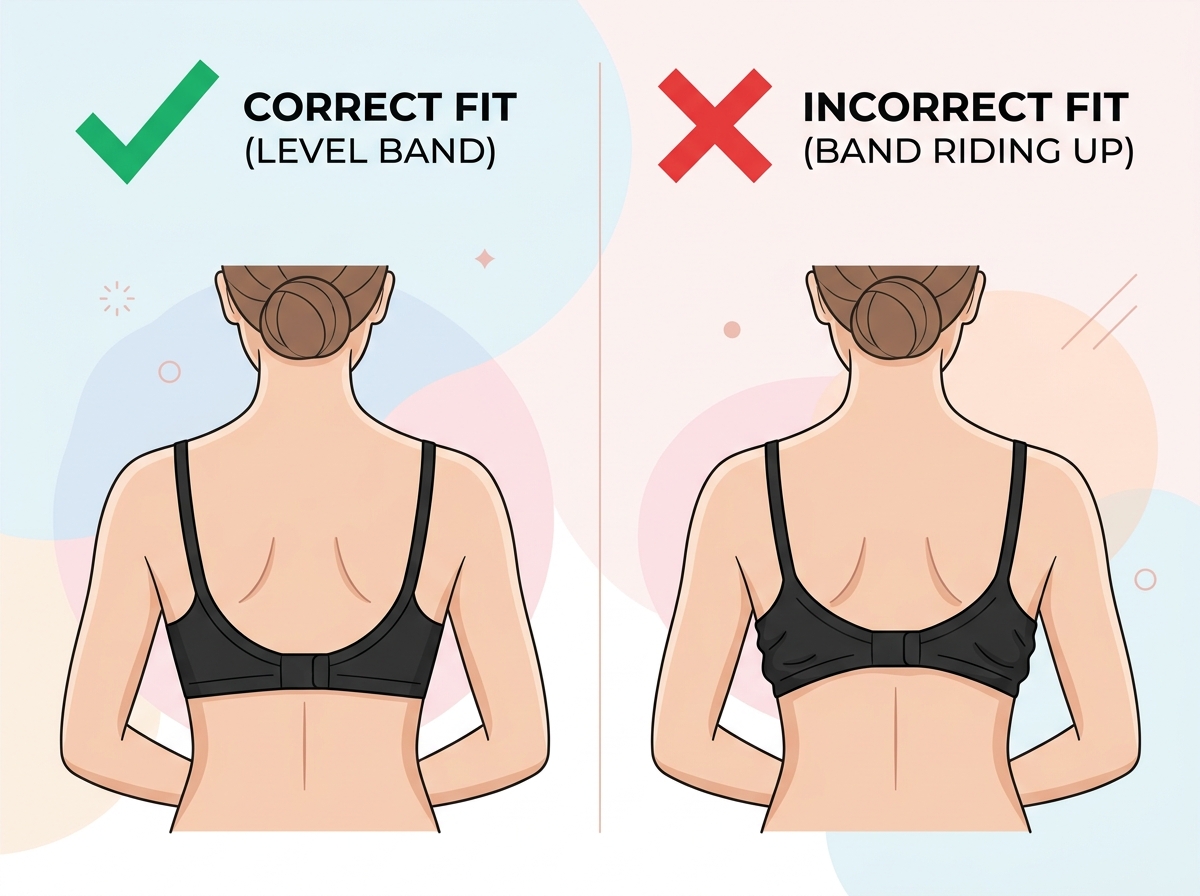
For a large bust, a loose band is disastrous. The band is meant to provide 80% to 90% of the bra’s support. When the band is too big, the weight of the breasts pulls the front of the bra down, causing the back of the band to ride up between your shoulder blades. The heavy lifting is then transferred entirely to the shoulder straps, leading to deep, painful grooves in your shoulders, neck pain, and chronic backaches.
Our Bra Size Calculator completely ignores the +4 method. Instead, it uses your raw, exact underbust measurements to recommend a band size that will sit firmly and securely against your ribcage, allowing the cups to do their job properly.
How to Take Accurate Measurements for a Large Bust
Measuring for a large or pendulous (soft tissue that hangs downward) bust requires a bit more care than measuring a smaller, self-supporting bust. Because breast tissue is soft and gravity plays a significant role, taking just one bust measurement standing up often underestimates the true volume of the breast.
Here is the expert-approved, multi-step measuring process for plus size and large breasts to use with our calculator.
Step 1: Gather Your Tools
You will need a soft, flexible measuring tape (often called a tailor’s tape). Do not use a metal construction tape. It’s best to measure while bare-breasted, but if you prefer, you can wear your best-fitting, unpadded, non-molded bra.
Step 2: The Three Underbust Measurements (Band Size)
Your band needs to anchor the bra to your body. Because plus-size bodies naturally have some “squish” or padding over the ribcage, we recommend taking three distinct underbust measurements to find the perfect level of snugness.
- Loose Underbust: Wrap the tape around your ribcage, directly underneath where your breast tissue attaches to your chest wall (the inframammary fold). Let the tape rest lightly against your skin without pulling it tight. Ensure it is parallel to the floor all the way around. Record this number.
- Snug Underbust: Pull the tape a bit tighter, to the tension you would expect a supportive bra band to feel. Record this number.
- Tight Underbust: Exhale completely, letting all the air out of your lungs, and pull the tape as tight as you possibly can, as if you were trying to break the tape. This tells the calculator the absolute minimum size your ribcage compresses to. Record this number.
Step 3: The Three Overbust Measurements (Cup Size)
Large breasts often have a lot of projection and mobility. To calculate the maximum volume of breast tissue accurately, you should take three overbust measurements.
- Standing Bust: Stand straight and wrap the tape around the fullest part of your breasts (usually across the nipples). Do not pull the tape tight; it should just rest on the breast tissue. Record this number.
- Leaning Bust: Bend forward at the waist at a 90-degree angle so your breasts point toward the floor. Wrap the tape around the fullest part of your breasts. For pendulous breasts, this measurement is often significantly larger than the standing bust and is crucial for capturing your true cup volume. Record this number.
- Lying Down Bust: Lie flat on your back on a firm surface. Your breast tissue will spread across your chest. Wrap the tape around the fullest part of your bust. Record this number.
Enter all of these numbers into our advanced bra size calculator to receive a highly accurate, customized size recommendation.
Understanding the Mechanics of Sister Sizes
When you use our tool, you might be given your primary calculated size, as well as several Sister Sizes. Understanding sister sizing is an essential skill for large-busted individuals, as different brands and styles can run tight or loose.
Sister sizes are bras that hold the exact same volume of breast tissue in the cups, but are mounted on different band sizes. As you go up in band size, you must go down in cup letter to maintain the same cup volume. As you go down in band size, you must go up in cup letter.
For example, if your calculator result is a 36H:
- If a specific brand’s 36 band feels too tight, you can try its sister size up in the band: 38G.
- If a 36 band feels too loose, you can try its sister size down in the band: 34I.
All three sizes (34I, 36H, 38G) have the exact same cup capacity, allowing you to fine-tune the band tension without sacrificing coverage for your breasts.
Beyond the Calculator: Breast Shape Matters
A bra size calculator large breasts tool will tell you your volume, but volume is only half the battle. The other half is shape. You could be wearing the mathematically perfect size, but if the bra is cut for a different breast shape, it will fit terribly.
Here are the key shape characteristics you need to know:
1. Root Width (Narrow vs. Broad)
The “root” is where your breast tissue attaches to your chest wall.
- Narrow Roots: Your breast tissue is mostly concentrated on the front of your chest. You need bras with narrower underwires so the wire doesn’t wrap entirely under your armpit and poke you.
- Broad Roots: Your breast tissue spreads wider, wrapping around your sides under your arms. You need bras with wider wires to ensure the wire encapsulates all the tissue and doesn’t sit on top of the side of your breast.
2. Projection (Shallow vs. Projected)
Projection refers to how far your breasts stick out from your body relative to their footprint.
- Shallow Breasts: The breast tissue is spread over a larger area of the chest wall. They don’t stick out very far.
- Projected Breasts: The breast tissue sticks out further from the body. Most large and pendulous breasts are highly projected. If you have projected breasts, you need bras with deep cups. Molded seamless “t-shirt” bras are typically shallow and will often fold or crumple at the bottom if worn by a projected breast.
3. Fullness (Top, Bottom, or Even)
Lean over 90 degrees and look at your breasts from the side.
- Full on Top (FOT): More tissue sits above the nipple. You need bras with open tops (like stretch lace balconies) to prevent the top edge from cutting in and creating a “quad-boob” effect.
- Full on Bottom (FOB): More tissue sits below the nipple. You need bras with deeper bottom cups.
- Even Fullness: Tissue is evenly distributed.
The Best Bra Styles for Plus Size and Large Breasts
If you’ve spent your life trying to fit your large bust into molded, foam-dome t-shirt bras, you are likely experiencing a lot of fit issues. Here are the most supportive styles for a heavier bust:
Cut-and-Sewn (Unlined Seamed) Bras
This is the holy grail for large breasts. Instead of a single piece of molded foam, the cups are constructed from multiple pieces of fabric sewn together (often a 3-part or 4-part cup). These seams provide immense structural integrity, shape, and lift that a seamless bra simply cannot achieve. They conform to your breast shape and offer incredibly deep cups for projected breasts.
Balconette Bras
Balconettes have lower necklines and straps set wider apart. They are excellent for lifting the breast from the bottom up, creating a rounded shape. They often feature stretch lace on the top panel, which is incredibly forgiving for top-fullness and size fluctuations.
Side Support Bras
Many large-busted women find that their breast tissue tends to splay outward towards their arms. Side support bras feature an extra panel of fabric (a “sling”) integrated into the outer edge of the cup. This panel pushes the breast tissue forward and toward the center of your chest, giving you a narrower, more streamlined silhouette and keeping your arms from brushing against your breasts when you walk.
Full Cup Bras
For maximum coverage, a full cup bra encapsulates the entire breast. This is a great everyday option if you have soft tissue that tends to spill out of lower-cut styles.
Expert Fit Troubleshooting
Even with the correct calculation, you might run into issues. Use this diagnostic checklist to troubleshoot your fit:
Problem: The band rides up my back.
- Solution: The band is too big. Your band should sit parallel to the floor on the loosest hook when new. Try a smaller band size (and remember to go up a cup letter to maintain the sister size volume).
Problem: The underwire digs into my ribs or armpits.
- Solution: If it digs under your arms, the cups might be too small or the wires too narrow. If it digs into your ribs at the bottom of the cup, the cups are likely too shallow, pushing the bra away from your body at the top and forcing the wire to hinge painfully into your ribs below. Try an unlined seamed bra with deeper cups.
Problem: My breasts spill over the top edge of the cup (Quad-boob).
- Solution: The cups are too small or the style is too closed on top for your shape. Go up a cup size or try a balconette with a stretch lace upper panel.
Problem: The center panel (gore) between the cups floats away from my chest.
- Solution: The gore should tack completely flat against your sternum. If it floats, the cups are too small and your breasts are pushing the bra away from your body. Go up in cup size until the center tacks flat. (Note: if your breasts are extremely close-set, you may need a plunge bra with a lower gore to achieve a flat tack).
Problem: The cups are gaping or wrinkling, especially at the top.
- Solution: If the band is secure but the cups gape, the cups might be too large, or they might be meant for a “Full on Top” shape while you are “Full on Bottom.” Sometimes, gaping in a molded bra simply means the bra’s rigid shape doesn’t match your organic shape.
Conclusion: Don’t Settle for Discomfort
You do not have to live with back pain, shoulder indentations, or the constant need to adjust your bra throughout the day. By abandoning outdated sizing methods and embracing a highly precise Bra Size Calculator, you can discover a world of supportive, beautiful lingerie designed specifically for plus-size figures and large busts.
Take your measurements carefully, consider your unique breast shape, and don’t be afraid to try unlined, seamed styles. Remember to always cross-reference your results using our international converter charts, as UK, US, and EU brands all use different sizing alphabets once you get past a D cup.
Empower yourself with accurate sizing, and start your journey toward unparalleled comfort and support today.
Frequently Asked Questions
Is the bra size calculator for plus size completely free to use?
Yes, our calculator is 100% free, private, and runs entirely on your device without storing your personal measurements. You can calculate as many times as you like without any hidden fees.
How often should I re-calculate my size?
We recommend measuring every 6 months. Your bra size isn't static; it will fluctuate with significant weight changes, hormonal shifts, pregnancy, nursing, or even a new fitness routine.
Why does the calculator ask for my leaning and lying down measurements?
For large and pendulous breasts, gravity pulls breast tissue down when standing, which can mask the true volume. Leaning forward allows all the tissue to hang free, providing the most accurate representation of the breast tissue that needs to be encapsulated by the bra cups.
Why are seamless "T-shirt" bras so hard to fit for a large bust?
Molded T-shirt bras are created by stretching a single piece of foam over a hot metal mold. This process can only create a wide, shallow shape. Large breasts are typically highly projected (they stick out more than they are wide). Trying to put a projected breast into a shallow molded cup is like trying to fit an orange into a bowl—it doesn't work well and causes gaps or wire digging.
I have back fat and "rolls" when I wear a bra. Does this mean the band is too tight?
Not necessarily! A properly supportive band has to grip your body firmly to support a heavy bust. This grip will naturally displace soft tissue (flesh/fat), creating a slight bulge. This is totally normal and means the bra is doing its job. If the band is comfortable and parallel to the floor, do not size up just to eliminate the "squish"—you will lose all your support.
Can a supportive bra for large breasts still be pretty?
Absolutely! In the past, larger cup sizes were relegated to beige "grandma bras." Today, many brands specialize in fuller busts (like Panache, Elomi, Freya, and Curvy Kate) offering stunning stretch lace, vibrant colors, and beautiful designs, all engineered to support H, J, and K cups perfectly.
Why Proper Fit Matters
Wearing a bra that fits correctly provides reliable daily support and all-day comfort. A well-fitted band takes the weight off your shoulders, prevents slipping or digging straps, and ensures your garments sit smoothly against your body.
Because body measurements and bra sizing matrices vary across different manufacturers, learning how to measure your bra size accurately is the most dependable way to establish your baseline. If your current bra feels uncomfortable, browse our bra fit diagnostic guide for common solutions.