
UK Bra Fitting Standards & The Health Benefits of Proper Support
Stop Guessing Your Size
Use our international bra size calculator to find your perfect fit in seconds.
UK Bra Fitting Standards & The Health Benefits of Proper Support
In the pursuit of daily comfort, proper support is an absolute necessity for physical well-being, yet an astonishing number of individuals continue to wear ill-fitting bras. A bra is much more than an everyday garment or a simple accessory; it serves as a foundational structural support system for your upper body. For decades, the bra fitting industry was clouded by outdated sizing methods, confusing size charts, and conflicting advice from high-street retailers. However, a significant shift has occurred. Understanding modern UK bra fitting standards helps turn bra sizing from a frustrating, arbitrary guessing game into a reliable, evidence-based practice focused on personal comfort, biomechanics, and long-term health.
When you invest the time to understand how a bra is truly meant to fit your body, you do more than just improve the silhouette of your clothing. You actively invest in your musculoskeletal health. A poorly fitting bra can be the hidden culprit behind a myriad of daily discomforts, from unexplained headaches to chronic shoulder tension. In this comprehensive pillar guide, we will delve deep into the mechanics of UK bra fitting standards, explore the profound health benefits of proper support, and empower you to assess your own bra fit with professional precision.
The Medical and Ergonomic Case for Proper Bra Support
To truly appreciate the importance of modern fitting standards, we must first look at the biomechanics of breast support. Breasts are primarily composed of glandular tissue, fat, and Cooper’s ligaments. These ligaments are thin bands of connective tissue that help maintain the breast’s structural integrity. However, Cooper’s ligaments are not exceptionally strong, and they are not designed to independently support the full dynamic weight of the breasts, especially for those with a fuller bust. Over time, gravity, high-impact physical activity, and age can cause these ligaments to stretch, leading to irreversible sagging (ptosis) if adequate external support is not consistently provided.
Healthcare professionals, physical therapists, and ergonomic specialists unanimously agree that a poorly fitting bra can contribute to significant, unnecessary physical discomfort. When a bra fails to provide proper support, the body is forced to dynamically compensate. The weight of the breasts pulls the upper body forward, altering your natural center of gravity. This constant forward pull forces the muscles in your upper back, neck, and shoulders to work overtime simply to keep you upright. Over hours, days, and years, this continuous muscle fatigue manifests as thoracic back pain, tight trapezius muscles, and chronic neck strain.
Furthermore, the consequences of an inaccurate fit extend beyond muscles and ligaments to the soft tissues and skin. Friction from a sliding, loose underband can cause severe skin irritation, contact dermatitis, and intertrigo (a painful rash that occurs in folds of skin where moisture is trapped). A bra that fits correctly, utilizing the principles of modern UK sizing, mitigates these issues by anchoring the support system securely to the ribcage, aligning with the body’s natural skeletal structure to distribute weight evenly and comfortably. Utilizing a modern, direct-underbust UK bra size calculator ensures your measurements prioritize true ergonomic support over arbitrary, outdated store sizing.
Historical Context: The Antiquated “+4 Method” vs. Modern UK Sizing Standards
One of the most persistent and harmful myths in the lingerie industry is the dreaded “+4 method.” To understand why this method is so problematic, we must look at its origins. In the mid-20th century, bras were manufactured using stiff, non-stretch materials. A 32-inch band was literally 32 inches of rigid fabric. To allow a wearer to breathe, move, and expand their ribcage, fitters advised adding four or five inches to the snug underbust measurement. If you measured 28 inches, you were told to wear a 32-band.
Today, bra manufacturing has been fundamentally revolutionized by the invention of elastane, spandex, and highly resilient stretch fabrics. A modern bra band is designed to stretch to its stated size. A modern 32 band stretches to fit a 32-inch underbust snugly. However, many major retailers, particularly in the US and parts of the UK, continued to use the +4 method for decades. Why? Because artificially adding inches to the band size and simultaneously reducing the cup size allows manufacturers to squeeze a wider range of people into a very narrow matrix of sizes (typically 32-38 bands, and A-DD cups). This maximizes manufacturing efficiency and profit while sacrificing the consumer’s fit, comfort, and health.
Modern UK bra fitting standards completely reject this antiquated approach. A proper UK fitting relies on direct, skin-level measurements. Your snug underbust measurement directly correlates to your band size. If your underbust measures 32 inches, you should typically start with a 32 band. This crucial shift ensures that the underband—not the delicate shoulder straps—carries the vast majority of the bust’s weight. When the band is artificially enlarged by the +4 method, it sits loosely on the body and rides up the back in a pronounced “U” shape. The burden of support immediately shifts to the shoulder straps, acting like a pulley system that digs painfully into the shoulders and pulls the neck forward.
The Anatomy of a Perfect Fit: UK Standards Broken Down
When assessing your bra fit according to professional UK standards, there are several key components you must evaluate. Think of this as an architectural inspection of your foundational support garment.
The Underband (The Foundation)
The underband is the most critical element of a bra, responsible for providing 80% to 90% of the overall support. According to UK standards, the band must fit firmly and sit perfectly level around the ribcage, parallel to the floor from front to back. You should be able to slide no more than two fingers beneath the band at the back. It should not move or ride up when you raise your arms. A firm band anchors the bra to your skeletal frame, transferring the heavy weight of the breasts to the sturdy ribcage rather than the delicate shoulder muscles.
The Center Gore (The Anchor)
The center gore is the fabric connecting the two cups at the front. In an underwired bra, this piece must “tack” or sit completely flat against your sternum (breastbone). It should not float, tilt, or hover above the skin. If the gore does not tack, the cups are likely too small, preventing the wires from effectively encapsulating and separating the breasts, which can lead to a uniboob effect and uncomfortable friction.
The Underwire (The Framework)
The underwire should perfectly trace the natural root (crease) of the breast. It must encompass all breast tissue, sitting flush on the ribcage rather than resting on the breast tissue itself. Wires that sit directly on breast tissue can cause severe pain, restrict lymphatic drainage, and potentially contribute to cysts or blocked ducts over time. At the sides, the wire should reach comfortably behind the breast tissue, aiming towards the center of the armpit.
The Cups (The Receptacle)
The cups should smoothly encapsulate the breast tissue without any spillage (the dreaded “quad-boob”) or wrinkling and gaping. Proper fit guidelines emphasize that the breast tissue should fill the cup entirely, providing a smooth silhouette. Keep in mind that cup size is not static; it is proportional to the band size. A 32F holds significantly less volume than a 36F. If you change your band size, you must understand how to calculate your sister size to maintain the exact same cup volume.
The Shoulder Straps (The Stabilizers)
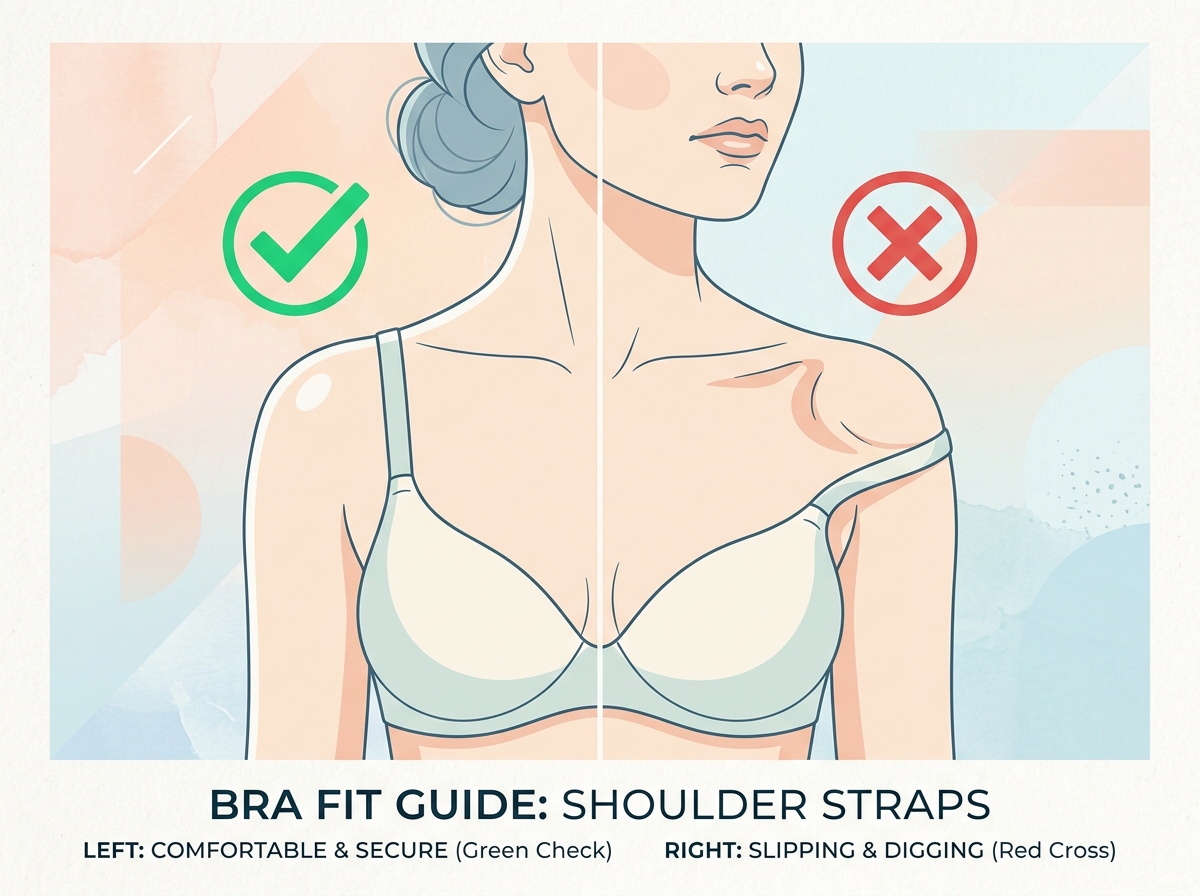
Straps should only bear 10% to 20% of the bust’s weight. They act primarily as stabilizers to keep the cups flush against the top of the chest and to provide minor shaping. They should be adjusted for gentle tension—tight enough not to slip off the shoulders, but loose enough that they do not dig into the skin, leave red indentations, or cause pain.
Physical Health Benefits of Adhering to Modern Bra Fitting Standards
When you transition from an ill-fitting bra to one that adheres to modern UK fitting standards, the health benefits can be immediate and profound, impacting your entire musculoskeletal system.
- Posture Correction and Spinal Alignment: A firm, properly fitted underband anchors the weight to the torso, positively altering your center of gravity. You will naturally stand taller, reducing the subconscious hunching that often accompanies heavy, poorly supported breasts. Proper spinal alignment reduces cumulative wear and tear on the intervertebral discs and surrounding musculature.
- Relief from Musculoskeletal Pain: By removing the heavy burden from the shoulder straps, you relieve the trapezius muscles from constant, agonizing strain. This directly correlates to a significant reduction in upper back pain, neck stiffness, and tension headaches that radiate from the base of the skull into the forehead.
- Prevention of Nerve Compression: When straps dig heavily into the shoulders under the weight of an unsupported bust, they can physically compress the brachial plexus—a vital network of nerves that sends signals from your spinal cord to your shoulder, arm, and hand. Chronic compression can lead to numbness, tingling (pins and needles), and radiating pain down the arms. A well-fitted bra eliminates this risk entirely.
- Improved Respiratory Function: While it may seem counterintuitive, a firm (but appropriately sized) band can actually improve breathing. When a bra is unsupportive and posture deteriorates into a slump, the ribcage is compressed, restricting diaphragmatic breathing. Standing upright with proper support opens the chest cavity, allowing for deeper, more efficient respiration.
- Skin Health and Circulation: A bra that moves, shifts, or slips constantly causes friction, leading to chafing, abrasions, and long-term hyperpigmentation. Furthermore, wires that sit directly on breast tissue can restrict crucial blood flow and lymphatic drainage. A proper fit ensures the bra moves with your body, protecting the delicate skin and promoting healthy circulation.
Specialized Support: Maternity, Sports, and Post-Surgical Needs
The necessity of proper support dictated by UK standards becomes even more critical during specialized periods of physical change or high-impact activity.
- Sports Bras: During physical activity, the breasts move in a figure-eight pattern. High-impact sports require maximum support to prevent irreversible stretching of Cooper’s ligaments. A properly fitted encapsulation sports bra—sized exactly like a standard bra with a firm band and defined cups—will dramatically reduce bounce and protect tissue integrity better than standard compression crop tops.
- Maternity and Nursing: During pregnancy and lactation, breast volume and ribcage dimensions fluctuate rapidly. Utilizing correct fitting standards ensures that expanding tissue is accommodated without restrictive wires causing mastitis or blocked ducts.
- Post-Surgical: Following breast augmentation, reduction, or mastectomy, precise, non-compressive support is paramount for proper healing, scar management, and implant settling. UK sizing principles help ensure that the delicate healing tissues are supported gently but securely from the underband.
Core Pillars of Ergonomic Bra Fitting: A Quick Reference
When checking your bra fit at home, or trying on new styles in a fitting room, continually evaluate these essential checkpoints to ensure your garment is promoting health rather than hindering it:
| Fitting Checkpoint | Fit Requirement | Potential Discomfort if Ignored |
|---|---|---|
| The Underband | Must be firm, level, and carry primary weight | Back pain, slipping band, poor support, poor posture |
| The Center Gore | Should sit flat against the sternum | Cup spillage, wire digging, uniboob effect |
| The Underwires | Encapsulate breast tissue completely, resting on ribs | Restricted circulation, bruised tissue, pain, cysts |
| The Cups | Smooth fit, no spilling, no wrinkling or gaping | Skin chafing, unsupportive bounce, visible lines |
| The Shoulder Straps | Adjusted for gentle tension, not bearing full weight | Shoulder grooving, neck strain, nerve compression |
Designing for Comfort and Daily Vitality
Choosing bras that respect modern UK bra sizing guidelines fundamentally improves your overall daily comfort and vitality. It means selecting garments crafted from fabrics that breathe and move, engineered bands that distribute weight evenly across a wider surface area, and cup constructions (like multi-part seamed cups) that fit, lift, and celebrate your natural shape.
The lingerie industry in the UK has long been a pioneer in creating highly inclusive sizing. While many global markets still focus on the limited matrix sizing, UK brands routinely manufacture cups from a D through to a K cup (and beyond), across a vast array of band sizes (often starting as small as a 28 band). This democratization of sizing means that achieving an ergonomic, healthy fit is accessible to nearly everyone, provided they are empowered with the correct measurements and knowledge.
Professional Fitting vs. Home Measurement
While visiting an independent, professional lingerie boutique for an expert fitting is highly recommended, it is crucial to advocate for yourself and understand the process. If a fitter attempts to measure you over a bulky top, or explicitly adds inches to your snug underbust measurement, you should politely question their methods. The best professional fitters use their eyes and experience, assessing the tension of the band and the volume of the cups on your body, often foregoing the tape measure altogether once they have established a baseline starting point.
However, you do not need to rely solely on professionals. Armed with a soft measuring tape and an understanding of modern UK standards, you can achieve remarkable accuracy from the comfort of your own home. Start by taking your snug underbust measurement to determine your foundational band size, followed by a standing and leaning bust measurement to estimate your cup volume accurately.
Conclusion
Never underestimate the profound impact that a meticulously fitted bra can have on your physical health, comfort, and mental well-being. By discarding antiquated sizing myths like the +4 method and wholeheartedly embracing modern UK bra fitting standards, you actively prioritize your body’s ergonomic needs. A well-fitted bra is a daily investment in your health—it protects your spine, supports your muscles, and allows you to move through your day with freedom, confidence, and absolute ease.
We encourage you to grab a measuring tape today and discover the transformative power of true, accurate support. Whether you use our free online bra size calculator to establish a highly accurate baseline, or take your knowledge to a trusted professional fitter, the ultimate goal is a seamless balance of supportive design and long-lasting comfort.
Frequently Asked Questions
What are modern UK bra fitting standards?
Modern UK standards emphasize accurate, skin-level underbust measurements to provide core band support and precise cup volume. They completely reject the outdated +4 method, ensuring the underband sits firmly and level on the ribcage to carry 80% to 90% of the bust's weight, taking the strain off the shoulders.
How does an online UK bra size calculator help?
Our online calculators apply direct measurement formulas based directly on modern UK fitting standards. This helps you find your accurate baseline UK size without arbitrary adjustments. They also help you calculate and identify your sister sizes, making off-the-rack fitting and brand comparison much easier and more reliable.
Can an ill-fitting bra cause physical discomfort?
Absolutely. Wearing an incorrect size—particularly a band that is far too loose combined with cups that are too small—forces the shoulder straps to carry the heavy weight of the breasts. This directly contributes to severe neck strain, chronic upper back discomfort, painful shoulder grooving, tension headaches, and skin chafing.
What happens if my bra band is too loose?
A loose band shifts the entire weight of your breasts onto your delicate shoulder straps, acting exactly like a pulley system. This leads to deep shoulder indentations, nerve compression, neck pain, headaches, and poor posture, as your body naturally hunches forward to compensate for the lack of structural support.
Why is the center gore important in bra fitting?
The center gore (the structural fabric piece between the cups) should lie perfectly flat against your sternum. This "tacking" ensures the underwires can properly separate and completely encapsulate the breast tissue rather than painfully sitting on top of it, providing superior stability, lift, and shape.
Why Proper Fit Matters
Wearing a bra that fits correctly provides reliable daily support and all-day comfort. A well-fitted band takes the weight off your shoulders, prevents slipping or digging straps, and ensures your garments sit smoothly against your body.
Because body measurements and bra sizing matrices vary across different manufacturers, learning how to measure your bra size accurately is the most dependable way to establish your baseline. If your current bra feels uncomfortable, browse our bra fit diagnostic guide for common solutions.