
What is a 'Shallow' Breast Shape and Why Do Standard Bra Size Charts Get It Wrong?
Stop Guessing Your Size
Use our international bra size calculator to find your perfect fit in seconds.
What is a ‘Shallow’ Breast Shape and Why Do Standard Bra Size Charts Get It Wrong?
You’ve done everything right. You took your measurements carefully, you inputted them into a highly-rated bra size calculator, and it told you that you are a 30E.
But when you go to the store and try on a 30E, the cups are hilariously empty at the top. The fabric wrinkles, there’s a huge gap, and you feel entirely defeated. You assume the calculator is broken and go back to wearing a 34B.
Before you give up on finding a perfect fit, you need to understand that bra size is only half the battle. The other half is shape. If your calculator size always results in gaping cups, you likely have what the lingerie industry calls a Shallow Breast Shape.
What Are Shallow Breasts?
Breast volume can be distributed on the chest in two primary ways: Projected or Shallow.
Imagine you have a specific volume of water (let’s say, 1 cup).
- Projected Breasts are like pouring that water into a narrow, deep champagne flute. The tissue sticks straight out from the chest wall.
- Shallow Breasts are like pouring that same cup of water onto a dinner plate. The tissue is spread thinly and widely across a larger surface area of the chest wall.
Women with shallow breasts often have tissue that starts very high up on the chest (near the collarbone) and wraps around the sides near the armpits. Because the tissue does not project forward, their breasts often appear much smaller visually than their mathematical volume suggests.
Why Do Calculators Fail Shallow Breasts?
Standard bra size charts and calculators work on simple circumference math. They subtract your ribcage measurement from your full bust measurement.
If you have shallow breasts, your tissue is spread out over a wide area. When you wrap a tape measure around your full bust, it records a large circumference because it is wrapping over all that spread-out tissue. The calculator accurately calculates your volume (e.g., a 5-inch difference, calculating to a DD).
However, bra manufacturers often design a DD cup expecting that volume to project forward like a champagne flute. When a shallow-shaped woman puts on that deep, projected cup, her tissue stays spread flat against her chest, leaving the front of the cup entirely empty and gaping.
The calculator wasn’t wrong about your volume; the bra style was wrong for your shape.
The Best Bra Styles for Shallow Breasts
If you have shallow breasts, you need bras that accommodate a wide footprint but don’t require forward projection.
Look for:
- Balconette / Balcony Bras: These have lower necklines and often feature vertical seams. They push tissue up from the bottom rather than requiring the breast to fill out a deep apex.
- Half-Cups and Demi Bras: These have open tops, preventing the dreaded gaping at the top edge of the cup.
- Bras with wide underwires: Shallow breasts often have a wide breast root, requiring wider wires so they don’t sit on breast tissue.
Avoid:
- Molded Seamless T-Shirt Bras: These are the absolute worst for shallow shapes. They are pre-formed into a rigid, projected shape. If your breast doesn’t match that exact shape, the cup will gap.
- Full Coverage Bras: These expect a lot of upper breast fullness to fill out the top fabric.
Finding Your Starting Point
Understanding your shape is the key to unlocking a perfect fit. However, you still need a mathematically accurate starting point to know what volume you are trying to fit into a balconette bra.
Don’t let a bad experience with a t-shirt bra deter you from finding your true size. Use our Bra Size Chart & Calculator to get your accurate baseline volume, and then apply your new knowledge of shallow shaping to select the right style in that size.
Why Proper Fit Matters
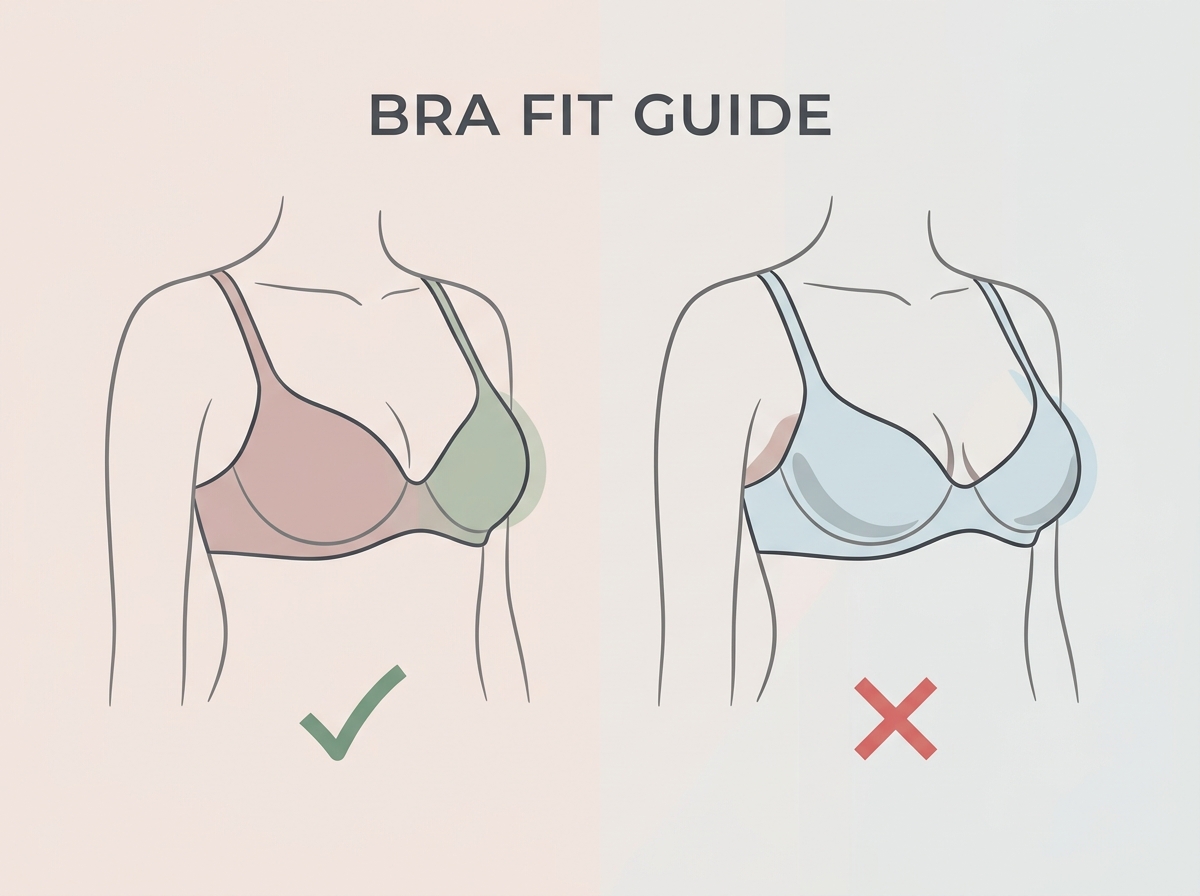
Wearing a bra that fits correctly provides reliable daily support and all-day comfort. A well-fitted band takes the weight off your shoulders, prevents slipping or digging straps, and ensures your garments sit smoothly against your body.
Because body measurements and bra sizing matrices vary across different manufacturers, learning how to measure your bra size accurately is the most dependable way to establish your baseline. If your current bra feels uncomfortable, browse our bra fit diagnostic guide for common solutions.