
Sports Bra Size Calculator: Find Your High-Impact Fit
Stop Guessing Your Size
Use our international bra size calculator to find your perfect fit in seconds.
The Ultimate Sports Bra Size Calculator Guide
For active women, a well-fitting sports bra is just as crucial to a workout as a good pair of sneakers. Whether you are running a marathon, practicing yoga, or doing high-intensity interval training (HIIT), breast bounce isn’t just uncomfortable—it can cause permanent damage to the delicate Cooper’s ligaments that support breast tissue, leading to premature sagging and severe back and neck pain.
Because sports bras serve a vastly different purpose than your everyday lingerie, they need to fit differently. This comprehensive pillar guide will explain the science behind sports bra fitting, how to accurately calculate your size, the difference between encapsulation and compression, and how to choose the perfect bra for your specific activity level.
Why Your Regular Bra Size Might Not Work for a Sports Bra
Many women assume they can just grab a sports bra in their everyday bra size and hit the gym. While your standard size is a great starting point, sports bras are constructed with firmer, less stretchy materials designed to restrict movement.
Because of this rigid construction, a sports bra band must fit significantly tighter than an everyday bra to provide necessary support. The band of a sports bra provides up to 80% of the breast support during vigorous exercise. If you use a standard bra size calculator for sports bra shopping, you might find the band feels overly constricting, or conversely, if you buy standard S/M/L sizing, you might lack adequate cup volume while the band is too loose.
This is why utilizing our specialized sports bra sizing tools and understanding the nuances of athletic fit are critical for your health and comfort.
How to Measure for a Sports Bra
To calculate the perfect high-impact fit, you need fresh, accurate measurements. Do not rely on your bra size from three years ago.
Step 1: The Band Measurement (Underbust)
- Wear an unpadded, non-compressive bra.
- Take a soft measuring tape and wrap it snugly around your ribcage, directly under your bust.
- Exhale deeply to ensure the tape is as tight as it would naturally sit during exercise.
- Keep the tape completely level across your back. Write down this number.
Step 2: The Bust Measurement (Overbust)
- Wrap the tape around the fullest part of your breasts.
- The tape should be flat but not compressing the breast tissue at all.
- Record this measurement.
Step 3: Use the Calculator
Input your measurements into our Bra Size Calculator. Whether you are asking “what size sports bra do I need?” in inches or centimeters, our system automatically computes the ideal ratio.
Compression vs. Encapsulation: Which Do You Need?
Sports bras generally fall into two structural categories. The type you need depends on your cup size and the intensity of your workout.
1. Compression Sports Bras
These bras work by pressing the breasts flat against the chest wall to restrict movement. They typically do not have individual cups and are often pulled over the head.
- Best For: A to C cups.
- Ideal Activities: Low to medium impact (yoga, cycling, weightlifting).
- Pros: Comfortable, seamless, good for floor work.
- Cons: Can cause a “uniboob” effect; insufficient for larger busts during high impact.
2. Encapsulation Sports Bras
These bras look more like everyday bras. They have individual, defined cups that surround and support each breast separately.
- Best For: D cups and larger.
- Ideal Activities: High impact (running, jumping rope, horseback riding, HIIT).
- Pros: Excellent bounce reduction, preserves natural shape, prevents chafing between breasts.
- Cons: Can be highly structured with underwires and intense clasps.
3. Combination (Encapsulation + Compression)
The gold standard for high-impact activities for large busts. These bras encapsulate each breast and use rigid outer panels to compress them against the chest.
How Should a Sports Bra Fit? The Golden Rules
Once you have your calculated size, you need to perform the “Fit Test” before removing the tags.
- The Band Test: The band should be snug—tighter than your everyday bra—but you should still be able to take a deep breath comfortably. You should only be able to fit two fingers under the band. If it rides up your back when you raise your arms, it is too loose.
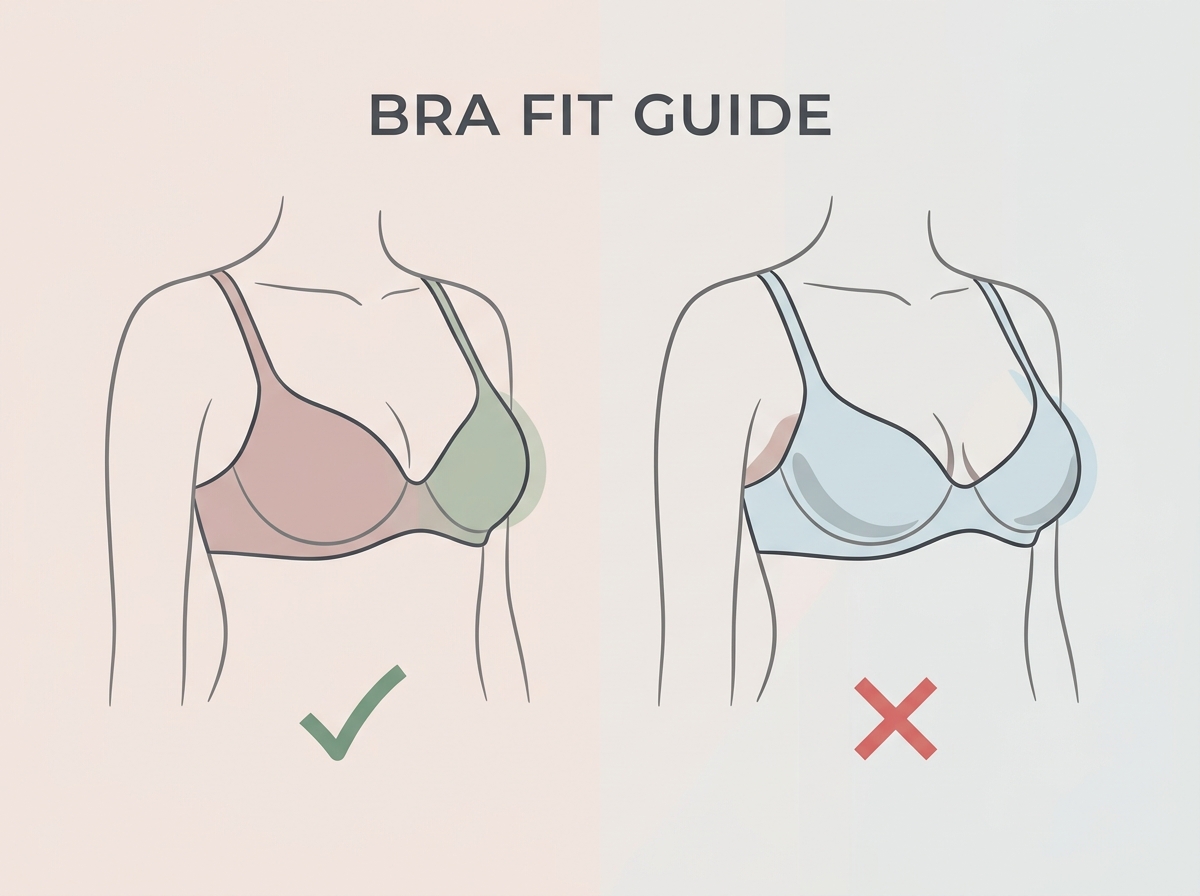
- The Cup Test: Your breasts should be fully contained within the cups. If you have “spillage” over the top or out the sides near your armpits, the cup size is too small. If the fabric is wrinkling or gaping, the cup is too large.
- The Strap Test: Straps should not dig into your shoulders (remember, the band should do the heavy lifting). Wide, padded straps are ideal for larger busts. Racerback styles help distribute weight and prevent straps from slipping during upper-body movements.
- The Bounce Test: Finally, do the jump test! Jump up and down in the dressing room or your bedroom. The bra should significantly minimize upward and downward bounce without causing pain.
Troubleshooting: When to Use Sister Sizes
If you find a sports bra that you love, but the fit is just slightly off, you can use Sister Sizes.
- If the band is suffocatingly tight but the cups are perfect, go up a band size and down a cup letter (e.g., from a 34D to a 36C).
- If the band is loose but the cups fit, go down a band size and up a cup letter (e.g., from a 34D to a 32DD).
Conclusion
Don’t let an ill-fitting sports bra hold you back from achieving your fitness goals. A highly supportive, precisely calculated sports bra is an investment in your physical health and athletic performance. Use our calculator, understand whether you need compression or encapsulation, and always prioritize a snug, secure band. Check your results against our international converter to ensure accuracy across all global activewear brands.
Frequently Asked Questions
Is a sports bra size the same as a normal bra size?
Not always. Because sports bras require a firmer hold, you may find that you prefer a slightly tighter band or a different cup volume depending on whether the bra uses compression or encapsulation. Always measure specifically for sports wear.
How long does a sports bra last?
A sports bra should never celebrate its first birthday if you use it regularly. With average use (washing after every sweaty workout), the elastic degrades in about 6 to 12 months. When the band loses its stretch, it's time to replace it.
Should my sports bra have underwire?
This is personal preference. For D+ cups, underwires wrapped in silicone or heavy padding offer superior encapsulation and support for high-impact activities. However, many modern wire-free sports bras use advanced fabrics that provide equal support without the wire.
Is the sports bra size calculator completely free to use?
Yes, our calculator is 100% free, private, and runs entirely on your device without storing your personal measurements.
How often should I re-calculate my size?
We recommend measuring every 6 months, or immediately if you have started a new intense training regimen that may have altered your back muscle mass or body fat percentage.
Why Proper Fit Matters
Wearing a bra that fits correctly provides reliable daily support and all-day comfort. A well-fitted band takes the weight off your shoulders, prevents slipping or digging straps, and ensures your garments sit smoothly against your body.
Because body measurements and bra sizing matrices vary across different manufacturers, learning how to measure your bra size accurately is the most dependable way to establish your baseline. If your current bra feels uncomfortable, browse our bra fit diagnostic guide for common solutions.