
Why Is It Important to Wear the Right Bra Size: A Deep Dive into Health and Posture
Stop Guessing Your Size
Use our international bra size calculator to find your perfect fit in seconds.
Why Is It Important to Wear the Right Bra Size: A Deep Dive into Health and Posture
In the quiet intersection of daily comfort and long-term health, few garments carry as much foundational importance as the bra. Yet, an overwhelming majority of individuals navigate their daily lives wearing the wrong size. Beyond the superficial concerns of aesthetic silhouettes or minor inconveniences lies a profound anatomical reality. Understanding why is it important to wear the right bra size is not merely about achieving a flawless look under your favorite silk blouse; it is a fundamental aspect of maintaining your musculoskeletal health, preserving breast tissue integrity, and fostering a posture that radiates confidence and vitality.
For decades, the conversation surrounding lingerie has been heavily skewed towards design, lace, and visual appeal. However, when we strip away the marketing, a bra is essentially a biomechanical support system. When this system fails—often due to incorrect sizing—the physical repercussions ripple throughout the body. The weight of the breasts, if not properly distributed and supported by the band and cups, is offloaded onto the delicate structures of the shoulders, neck, and upper back. This is where the cascade of a bad bra fit begins, leading to a spectrum of discomforts that many dismiss as an unavoidable part of womanhood.
Let us elevate the discourse and delve into the physiological imperatives of proper support, examining how the right fit can transform not just your wardrobe, but your physical well-being.
The Foundation of Posture: Beyond Standing Up Straight
Posture is the architectural alignment of your body. When you wear a bra that lacks the structural integrity to support your bust, the immediate consequence is a forward shift in your center of gravity. A band that is too loose—a common error—transfers the burden of support from the sturdy ribcage to the fragile shoulder straps.
This mechanical failure forces the shoulders to round forward and the upper back to hunch in a subconscious effort to counterbalance the weight. Over time, this chronic misalignment places tremendous strain on the cervical and thoracic spine. You might experience persistent tension headaches, a stiff neck, or a dull, continuous ache between your shoulder blades. By ensuring your band is snug and parallel to the ground, taking 80% of the weight, you liberate your shoulders. The result is a natural, effortless elongation of the spine. You stand taller, breathe deeper, and project an aura of self-assured grace. For a detailed breakdown of how a band should fit, you can consult our comprehensive fit guide.
Alleviating the Burden: Shoulder Indentations and Nerve Compression
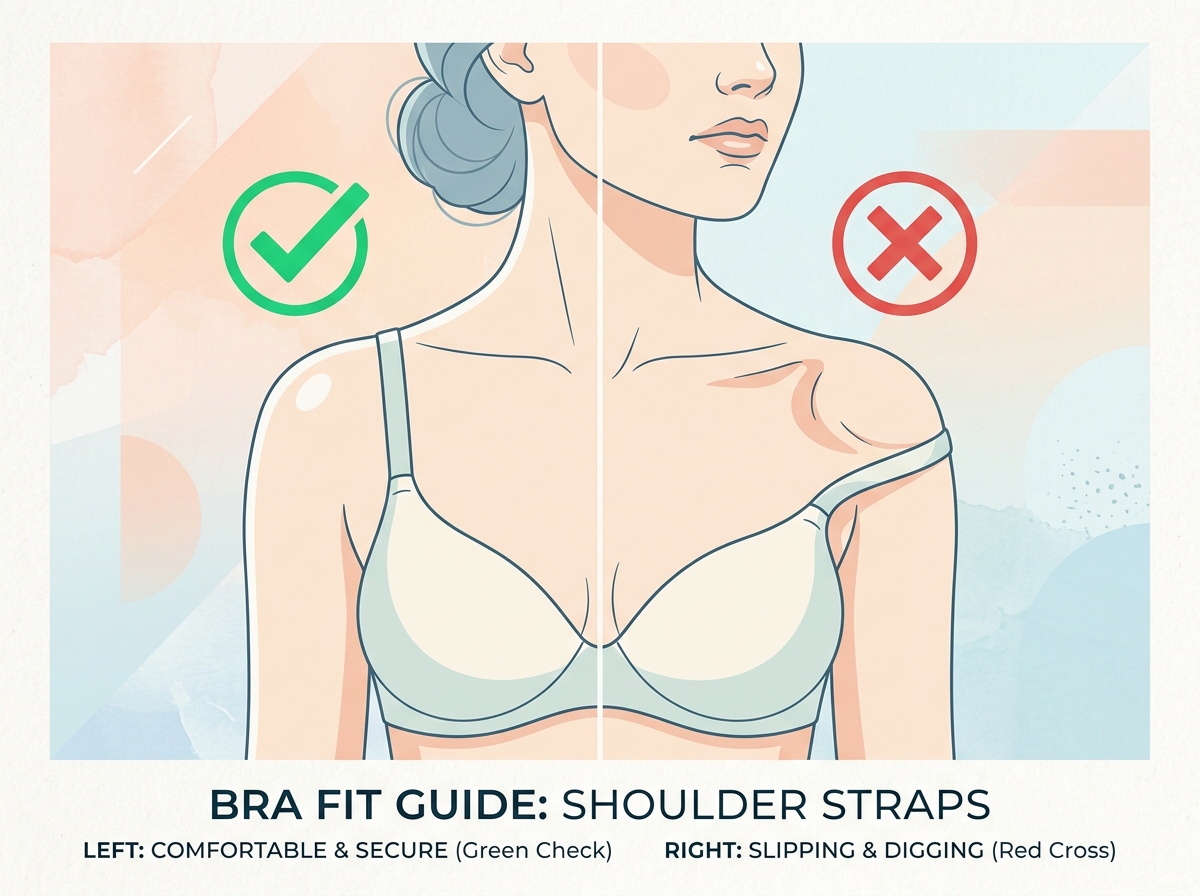
One of the most telling, and physically damaging, signs of a bad bra fit is the presence of deep, painful grooves on the shoulders. These indentations are not just cosmetic blemishes; they are the physical manifestation of concentrated, prolonged pressure on the trapezius muscles and underlying neurovascular structures.
When straps are over-tightened to compensate for a loose band, they dig into the soft tissue. This constant downward force can compress the brachial plexus, a network of nerves that sends signals from your spine to your shoulder, arm, and hand. Symptoms of this compression include tingling, numbness, and radiating pain down the arms. In severe cases, the tissue damage can become permanent, leaving lasting indentations long after the bra is removed. The solution lies not in wider straps, but in a mathematically accurate band size that anchors the garment firmly around the torso, rendering the straps a secondary stabilizing feature rather than the primary lifting mechanism.
Tissue Health and Lymphatic Flow
The breast is composed of delicate glandular and adipose tissues, devoid of structural muscle. It relies entirely on the overlying skin and the Cooper’s ligaments—thin bands of connective tissue—for shape and support. A poorly fitted bra, particularly one with cups that are too small, compresses this tissue relentlessly.
This compression can have insidious effects on your health. Firstly, it restricts lymphatic drainage. The lymphatic system, which relies on movement and lack of constriction to filter toxins and waste from the tissues, can become sluggish when subjected to tight, binding underwires.
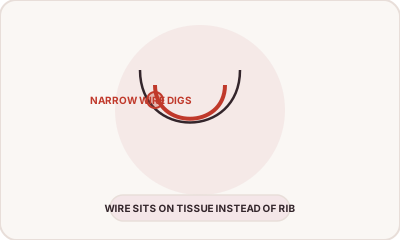
Furthermore, let us address a specific, sharp discomfort: how to avoid underwires digging into breasts at the sides. This painful phenomenon occurs when the underwire, designed to encapsulate the breast root, sits directly on the breast tissue instead of resting flat against the ribcage behind the breast. This not only causes severe acute pain and bruising but can also damage the Cooper’s ligaments over time, accelerating natural sagging. The wire must trace the natural crease of your bust perfectly. If it pinches or pokes the sides, it is an unequivocal signal that a larger cup volume or a different wire shape is required.
The Psychological Dimension of Comfort
We must not underestimate the psychological toll of chronic physical discomfort. The constant need to adjust slipping straps, pull down a riding band, or discreetly shift an aggressively digging underwire consumes mental energy. It creates a subtle but pervasive background noise of physical distraction that detracts from your focus, your productivity, and your overall mood.
When you discover your true size, perhaps by utilizing a precise bra size calculator, the transformation is often described as a revelation. The absence of pain and the sensation of weightless support allow you to move through your day unencumbered. It is an investment in your daily peace of mind, a silent luxury that you wear intimately against your skin.
Navigating the Fitting Process
Understanding why it is so crucial to find the right size is the first step; taking action is the next. The body is not static. Hormonal fluctuations, weight changes, age, and fitness routines all alter your breast tissue and ribcage dimensions. What fit flawlessly a year ago may now be the source of your back pain.
We advocate for a mindful approach to your lingerie wardrobe. Discard the arbitrary letter and number combinations you have clung to and approach sizing as a fluid, personalized metric. Look for the technical indicators of a flawless fit: a tacking gore (the center piece lying flat against the sternum), smooth cups free of gaping or spillage, a level band that stays put when you lift your arms, and wires that cradle the tissue without ever crossing its boundaries.
When evaluating a new piece, perform the scoop and swoop method to ensure all breast tissue is brought forward from the sides and comfortably settled into the cups. This simple technique often reveals that a cup size previously thought adequate is, in fact, too small. Additionally, assess the fabric and construction. High-quality materials with thoughtful elasticity will move with your body, adapting to your breathing and motion without losing their supportive integrity. Remember that different styles—be it a balconette, plunge, or full-coverage design—will interact differently with your unique breast shape. Therefore, understanding your shape is just as critical as knowing your numerical size.
Ultimately, finding the perfect fit is an ongoing journey rather than a one-time destination. By staying attuned to your body’s signals and prioritizing structural support over mere aesthetics, you safeguard your health and elevate your daily experience.
Frequently Asked Questions
Why is it important to wear the right bra size?
Wearing the right bra size is crucial because it ensures proper biomechanical support, which helps alleviate back and shoulder pain, improves your overall posture, and maintains the health of delicate breast tissues.
What are the signs of a bad bra fit?
Key indicators include deep shoulder indentations, a band that rides up your back, cups that overflow or gape, and an underwire that digs painfully into your ribs or breast tissue.
How to avoid underwires digging into breasts at the sides?
To prevent this, you must ensure your cup size is voluminous enough to fully encapsulate the breast tissue, and that the wire width matches your breast root. The wire should rest on the ribcage, not the breast itself.
Can a poorly fitted bra cause permanent shoulder indentations?
Yes. When the band is too loose, the straps bear the weight, leading to consistent, concentrated pressure that can cause semi-permanent or permanent grooves in the shoulder tissue and even nerve compression.
Stop Guessing, Start Calculating
Finding your perfect fit shouldn’t be a mystery. Use our advanced Bra Size Calculator or explore your alternative sizing options with our Sister Size Calculator to find a fit that feels custom-tailored to your unique shape.
Why Proper Fit Matters
Wearing a bra that fits correctly provides reliable daily support and all-day comfort. A well-fitted band takes the weight off your shoulders, prevents slipping or digging straps, and ensures your garments sit smoothly against your body.
Because body measurements and bra sizing matrices vary across different manufacturers, learning how to measure your bra size accurately is the most dependable way to establish your baseline. If your current bra feels uncomfortable, browse our bra fit diagnostic guide for common solutions.